
The right GoHighLevel alternative depends on what you actually use GoHighLevel for. An agency reselling software needs a different shortlist from a sales team managing opportunities—or a growth operator trying to connect paid spend, website behavior, and appointment-setting calls.
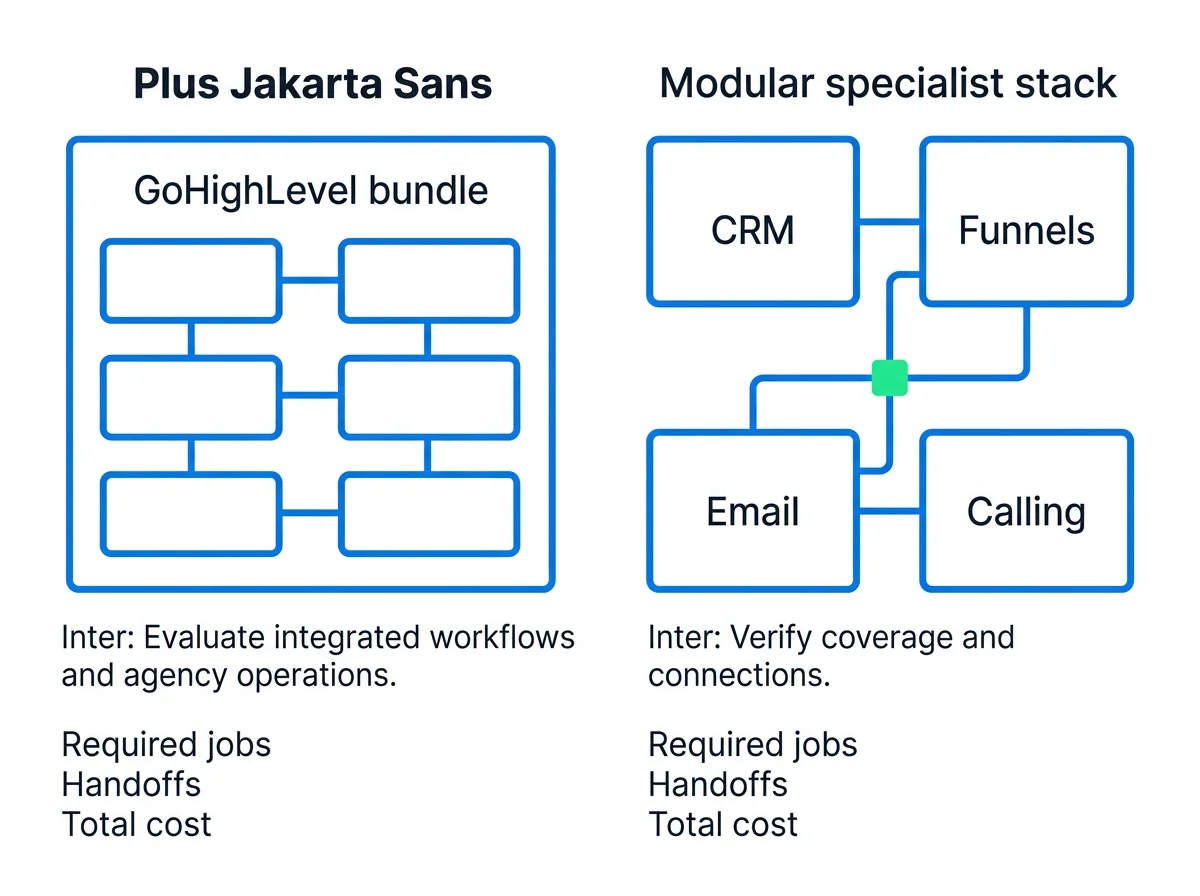
GoHighLevel brings agency operations, CRM, funnels, communication, automation, and resale into one platform. That bundle is a real strength when several of those jobs matter to your business. No alternative should be assumed to replace the full GoHighLevel bundle. A focused tool can replace one important workflow without replacing your entire operating model.
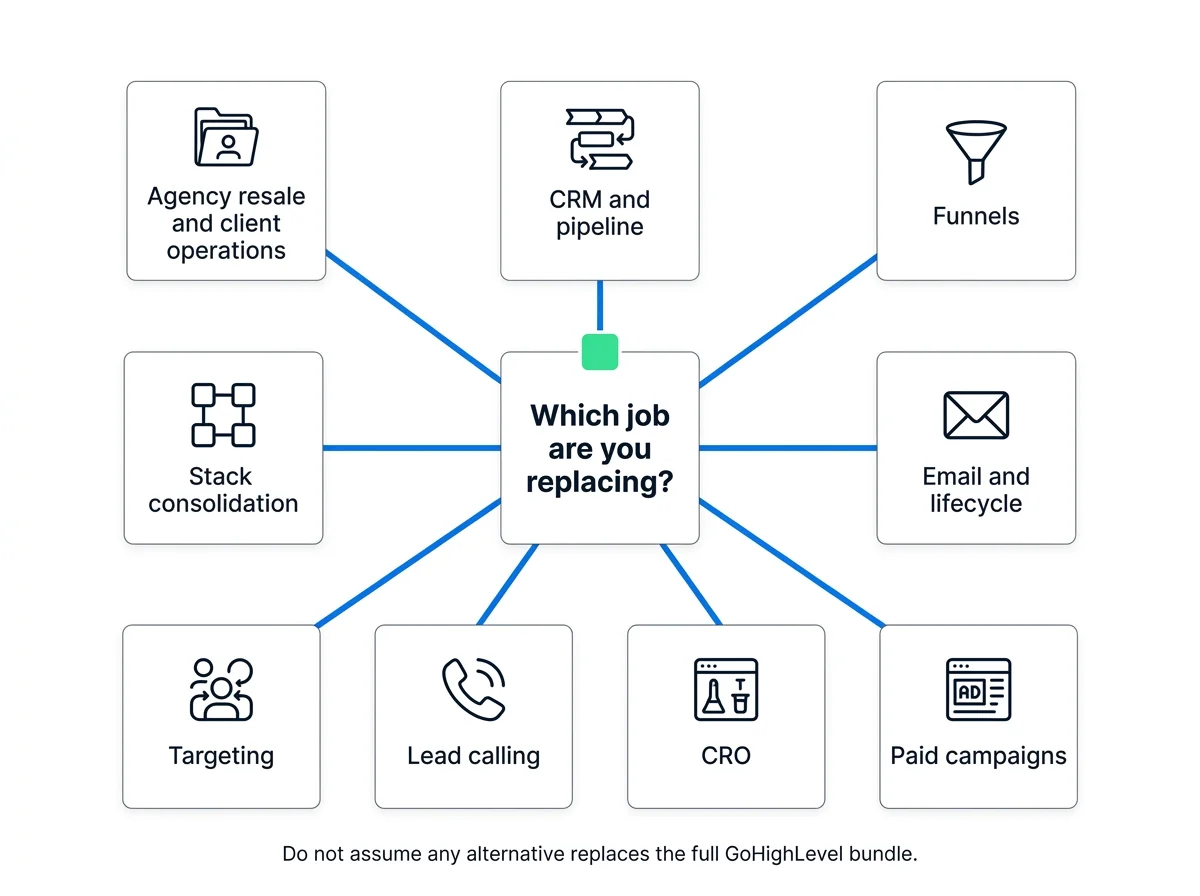
What are you trying to replace?
Before comparing vendors, list your current GoHighLevel workflows. Mark each one essential, useful, or unused. Your essential workflows define the shortlist; unused features should not decide the purchase.
- Agency resale and client workspaces: delivering software under your brand and organizing client operations.
- CRM and pipeline: keeping lead records, ownership, sales activity, and deal stages together.
- Funnels and landing pages: creating destinations for campaigns and guiding visitors toward a submission or purchase.
- Email and lifecycle automation: segmenting audiences and following up based on their stage or behavior.
- Paid campaign research and execution: developing campaign direction and managing advertising work.
- Conversion optimization: understanding where visitors struggle and deciding what to improve.
- Lead response and appointment setting: moving submitted leads toward a conversation.
- Whole-stack consolidation: reducing the number of systems your team maintains.
Replace the job that is causing friction—not the entire platform by default.
For example, a team that mainly uses pipelines and sales follow-up should evaluate sales workflows first. A team with a working CRM but unclear campaign performance should evaluate the campaign and optimization layer. Those are different purchasing decisions.
Quick comparison: 10 GoHighLevel alternatives by use case
The table separates each platform’s product focus from the workflow we would put it on a shortlist for. These are use-case recommendations, not a universal ranking or a feature-parity scorecard.
| Platform | Product focus | Shortlist when replacing |
|---|---|---|
| Vendasta | White-label resale and agency marketplace | Agency reseller and client-account workflows |
| Simvoly | White-label websites and funnels | Branded website and funnel delivery |
| Systeme.io | Budget-oriented all-in-one platform with a free entry tier | A simpler all-in-one operating approach |
| HubSpot | CRM, reporting, and a modular B2B platform | CRM-centered sales and marketing operations |
| Close | Sales pipelines, calls, and email | Communication-led sales follow-up |
| Pipedrive | Visual sales pipeline management | Deal tracking and pipeline workflows |
| ClickFunnels | Funnels and checkout flows | Funnel-led acquisition and purchasing journeys |
| Kartra | Courses, memberships, and commerce | Creator and digital-product workflows |
| ActiveCampaign | Email automation and segmentation | Lifecycle messaging and nurture |
| Superpage | AI campaign research, execution, CRO, and lead calling | Campaign operations and appointment-setting calls |
Agency resale, client operations, and all-in-one options
If your business sells software access or manages multiple clients, the operating model matters as much as the marketing tools. A good funnel builder alone does not answer questions about reseller delivery, client organization, and account administration.
1. Vendasta: agency resale and marketplace delivery
Vendasta centers on white-label resale and an agency marketplace model, with client-account and reseller workflows. Its focus makes it a relevant starting point for agencies whose GoHighLevel dependency is the business of delivering software and services to clients.
Fit judgment: put Vendasta on the shortlist when your first question is “How will we package and deliver our client offering?” Treat funnel creation, sales follow-up, and campaign execution as separate requirements in that evaluation—not automatic consequences of choosing a reseller platform.
2. Simvoly: white-label websites and funnels
Simvoly’s white-label website and funnel focus makes it relevant when those assets are the core of your client deliverable. This is a narrower replacement job than running an entire agency operating system.
Fit judgment: consider Simvoly when branded website and funnel delivery sits at the center of your service. Keep client communications, CRM workflows, and other operating needs as distinct items on your requirements list.
3. Systeme.io: a budget-oriented all-in-one shortlist
Systeme.io belongs in the budget-oriented all-in-one category and offers a free entry tier. That makes it relevant for a business exploring a consolidated approach without starting from an agency-resale requirement.
Fit judgment: shortlist it when entry cost and simplicity drive the decision. Do not let a free entry tier stand in for the full cost of your required workflow. Agency operations and communication requirements still need their own place in the comparison.
CRM and sales-pipeline alternatives
For sales-led teams, the useful comparison starts with a lead becoming an owned opportunity. How does the team record activity, see deal stages, and decide what to do next? A CRM-centered shortlist is different from a white-label agency shortlist.
4. HubSpot: CRM-centered B2B operations
HubSpot combines a CRM focus with reporting and a modular platform model. It belongs in the conversation when customer records and B2B sales and marketing operations are the main replacement job.
Fit judgment: consider HubSpot when multiple teams need to work around customer and opportunity data. Build the evaluation around the modules your workflow needs. Treat agency resale as a separate decision rather than equating a broad business platform with a white-label operating model.
5. Close: communication-led sales work
Close focuses on sales pipelines, calls, and email. That makes it relevant when your team’s daily work revolves around contacting prospects and moving conversations toward opportunities.
Fit judgment: shortlist Close when the sales communication workflow is the part of GoHighLevel you want to replace. Evaluate pages, lifecycle marketing, and agency delivery separately. Calls used by a sales team are also a different buying requirement from AI appointment-setting calls.
6. Pipedrive: visual pipeline management
Pipedrive’s visual pipeline focus makes it relevant for teams organizing deals and sales progression. It is a focused starting point when pipeline management—not whole-stack consolidation—is your central requirement.
Fit judgment: consider Pipedrive when you want the shortlist to revolve around how reps manage opportunities. Map the rest of the lead journey around that CRM choice, including acquisition, nurture, and appointment setting.
Funnels, commerce, and email-lifecycle alternatives
These tools address different parts of the marketing journey. Funnel construction, digital-product delivery, and email nurture should not be treated as interchangeable simply because each involves automation.
7. ClickFunnels: funnels and checkout journeys
ClickFunnels specializes in funnels and checkout flows. Its focus is relevant when your essential GoHighLevel workflow is guiding a visitor through a conversion or purchasing journey.
Fit judgment: shortlist it when the funnel itself is the main asset you need to replace. Describe what happens after the conversion as a separate workflow so that sales ownership and follow-up remain visible in the decision.
8. Kartra: creator businesses and digital commerce
Kartra’s focus includes courses, memberships, and commerce. That makes it relevant to creators and digital-product businesses evaluating the customer journey around an offer.
Fit judgment: consider Kartra when selling and delivering digital products shapes your requirements. An agency running client accounts has a different operating problem, even if both businesses need marketing automation.
9. ActiveCampaign: email automation and segmentation
ActiveCampaign focuses on email automation, segmentation, and lifecycle marketing. It is a relevant specialist when the replacement job is moving people through nurture and customer messaging.
Fit judgment: put it on the shortlist when audience segmentation and follow-up logic drive your purchase. Compare the actual sequences your team uses, including triggers and exit conditions, rather than deciding from the number of automation features.
Paid campaigns, CRO, and lead calling
10. Superpage: the campaign-operations layer
Superpage is an AI marketing platform for researching, building, publishing, and optimizing campaigns across connected marketing tools. Its role in this shortlist is campaign operations: deciding what to launch, executing supported advertising workflows, identifying conversion bottlenecks, and calling leads as appointment setters.
- Google Ads: keyword research and CAPI implementation support campaign planning and conversion signals.
- Meta Ads: Meta advertising workflows support ad copy and creative generation, campaign configuration, and publishing to a connected Meta account.
- Conversion optimization: AI CRO uses actual website session recordings and first- and last-touch attribution to identify bottlenecks and recommend what to optimize next.
- Lead calling: AI Voice Agents call leads as appointment setters.
Fit judgment: consider Superpage when the unresolved job is campaign research, paid-media execution, post-click optimization, or appointment-setting calls. That evaluation is distinct from CRM or agency-resale parity: campaign-operations coverage is not the same thing as replacing GoHighLevel’s broader agency bundle.
For a closer look at that particular distinction, read the GoHighLevel vs Superpage workflow comparison. Here, Superpage remains one option among several, chosen for a specific replacement job.