
For SaaS marketing teams, speed to market is the ultimate competitive advantage. Whether you are launching a highly anticipated product feature, deploying a time-sensitive webinar, or executing a strategic pivot to capitalize on a competitor's misstep, the velocity at which you move from strategy to live campaign dictates your growth.
Yet, despite the massive influx of AI writing assistants and conversational bots, the actual end-to-end execution of a SaaS marketing campaign remains painfully slow. Why? Because while a generic AI chatbot can generate a blog post draft or suggest email subject lines in seconds, setting up a cohesive campaign across a heavily fragmented marketing stack still takes days, if not weeks.
Key Takeaways: AI Marketing Automation for SaaS
- The Stack Bottleneck: Disconnected tools (landing pages, emails, ad managers) kill campaign velocity, regardless of how fast AI writes your copy.
- Agents over Prompts: The next evolution of marketing shifts away from single-chatbot prompt chains toward coordinated AI specialists.
- Complete Orchestration: Real AI automation builds the page, wires the form, drafts the nurture sequence, and readies the ad creative simultaneously.
- Consolidated ROI: Replacing multiple point solutions with an integrated AI platform drastically reduces software overhead and context switching.
The SaaS Fragmentation Problem
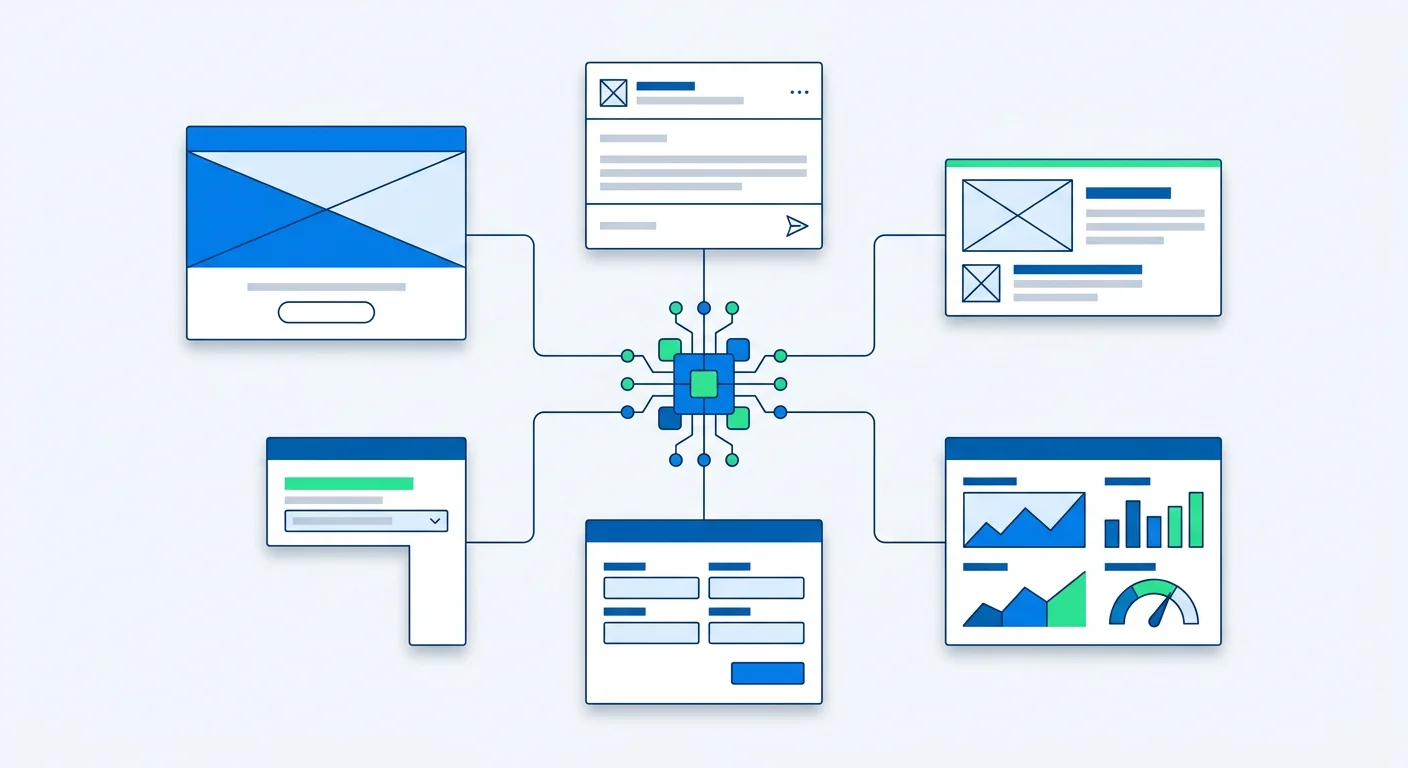
Look at the typical SaaS marketing tech stack. It is a sprawling web of point solutions. You have one tool for landing pages, a separate CRM or email platform for lead nurturing, another application for scheduling social media, and yet another dashboard for managing Meta and Google ads.
When you inject basic AI prompt wrappers—like ChatGPT or isolated copywriting tools—into this mix, you are merely introducing another disconnected tab to your browser. A prompt wrapper might write a clever value proposition, but it fundamentally lacks context. It does not know how that headline fits into your broader demand generation strategy, nor can it automatically deploy that headline to your live environment. You are left acting as the manual router: copying from the AI, pasting into your CMS, mapping fields in your form builder, and tweaking the ad copy in a separate portal.
The Hidden Costs of Disconnected Tools
This fragmentation breeds inefficiency. For early-stage B2B SaaS companies and lean revenue teams, the coordination overhead alone can sink a campaign before it begins. High-friction environments lead to:
- Inconsistent Messaging: When copy is manually ported between ads, landing pages, and email nurture sequences, the core value proposition often degrades or misaligns.
- Lead Leakage: Stitching forms to CRMs via middleware (like Zapier) creates multiple failure points. A broken webhook means lost revenue.
- Sluggish Iteration: If a campaign underperforms, pivoting requires updating the ad, the page, the form, and the email in four different systems.
"SaaS marketers don't need more standalone tools or smarter chatbots. They need coordinated execution across their entire funnel. The future is marketing built by agents, not prompts."
The Paradigm Shift: From Prompting to Orchestration
The next major leap in SaaS marketing is not about engineering a better prompt; it is about deploying coordinated AI marketing agents.
Unlike a single monolithic language model that answers isolated queries, AI agents operate as specialized digital workers. In a coordinated platform, you have a strategic planning agent, a copywriting agent, a layout and design agent, and a deployment agent. Because these agents share a centralized strategic context, they collaborate to build the entire campaign as a unified asset.
Deconstructing the Agent-Led Campaign Workflow
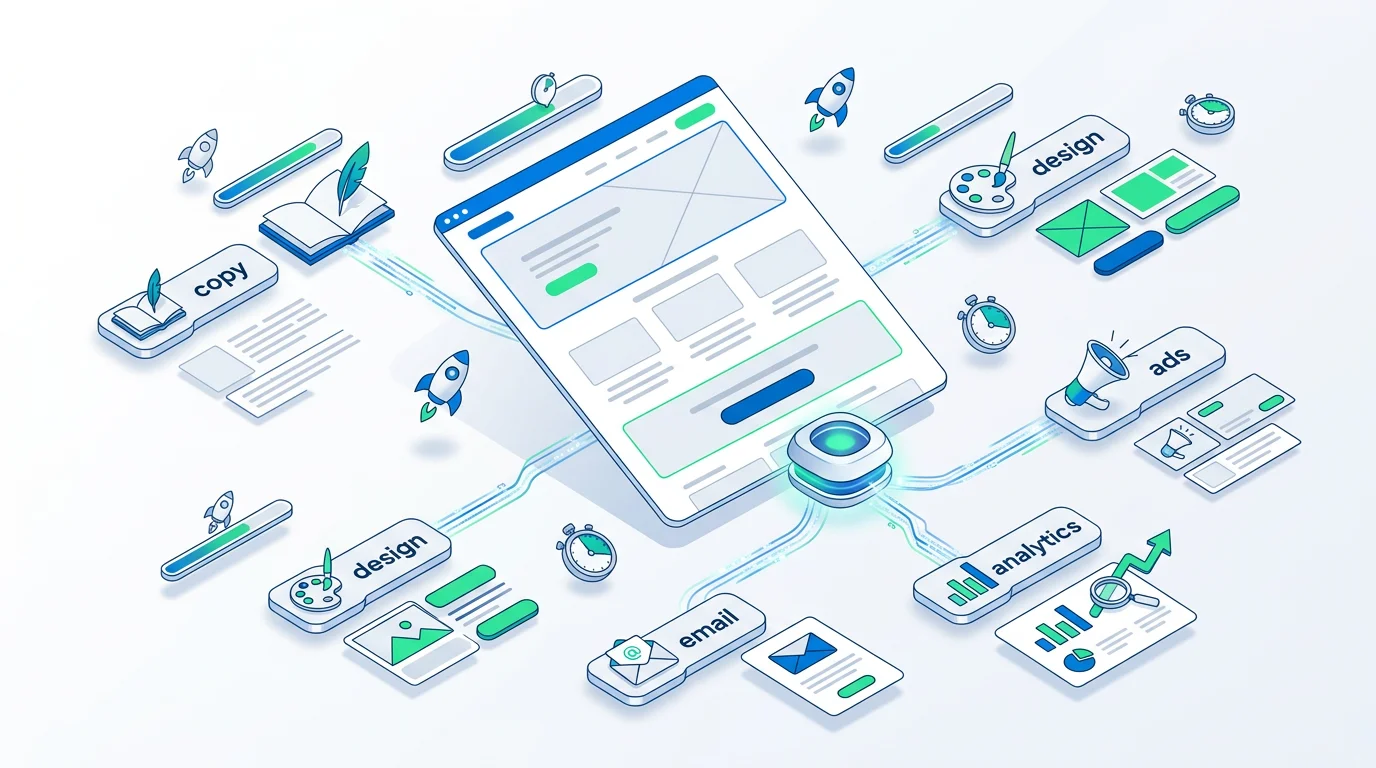
To understand the practical impact of replacing your fragmented stack with an AI agent orchestrator, let us walk through a typical SaaS product launch. In a traditional setup, this involves creative briefs, wireframing, copywriting, design approvals, development staging, and rigorous QA. In an orchestrated AI platform, the workflow looks entirely different.
AI Pages & Funnel Generation
You provide the platform with a simple brief or documentation of your new feature. Instantly, the strategy and design agents collaborate to construct a high-converting landing page and funnel. This isn't a wireframe—it is a fully deployed, mobile-responsive page featuring brand-aligned typography, structured problem/solution sections, and localized copy. You bypass drag-and-drop builders entirely.
Forms, Qualification & Automated Handoff
A landing page is useless without lead capture. The agents automatically integrate forms and qualification logic directly into the funnel. Based on the perceived value of the offer, the system configures the appropriate routing rules—sending enterprise leads to a booking calendar while routing self-serve prospects to a frictionless checkout or trial signup.
Context-Aware Email Nurture
Because the AI agents are coordinated, the email marketing agent natively understands the exact value proposition deployed on the landing page. It instantly drafts a multi-touch drip sequence specifically designed to nurture the leads captured from that exact form. No tone mapping or manual rewriting required.
Meta & Ad Campaign Synchronization
Finally, the system outputs matching ad creative and copy. Need to run Meta advertising to drive top-of-funnel traffic? The ad agent pulls the highest-converting headlines from the landing page and formulates compliance-ready ad variants, ensuring unbroken message continuity from the first ad click to the final email.
Deep Dive: A Researched SaaS-Specific Workflow
To truly understand how orchestration allows teams to launch SaaS campaigns faster, we must look at a specialized use case: launching a Product-Led Growth (PLG) trial campaign combined with an enterprise demo route. In the traditional model, this dual-funnel approach requires heavy technical setup. You need custom routing in your form builder, dynamic tags in your CRM, and split email paths in your marketing automation platform.
When you replace your fragmented marketing stack with a unified platform, the workflow simplifies dramatically. Coordinated AI marketing agents handle the technical routing natively. Here is exactly how this SaaS-specific workflow operates behind the scenes:
- Step 1: The Unified Feature Brief: You input your release notes and target audience into the strategy agent. It instantly grasps the distinction between end-users (seeking a free trial) and executives (seeking ROI and a demo).
- Step 2: Dual-Intent Page Generation: The design and copy agents generate a landing page featuring two distinct call-to-actions. The copy dynamically shifts based on which button the user interacts with, bypassing the need for duplicate pages.
- Step 3: Intelligent Form Routing: The form agent deploys a lead capture modal with conditional logic. If a user selects a company size over 500 employees, the system routes them directly to a calendar booking widget. If under 500, it passes them straight to the self-serve signup checkout.
- Step 4: Split-Track Nurturing: Simultaneously, the email agent writes two distinct multi-touch sequences. The enterprise track focuses on security, compliance, and team ROI. The PLG track delivers quick-start tutorials and "aha moment" activation prompts.
This level of precision is what defines truly automated marketing campaigns. You are not just generating text; you are generating fully functioning, segmented revenue systems in minutes.
Comparison: The Fragmented Stack vs. Consolidated AI Automation
| Campaign Element | Traditional Fragmented SaaS Stack | Superpage AI Agent Orchestration |
|---|---|---|
| Strategy & Briefing | Manual Google Docs passed between product marketing, copywriters, and designers. | Centralized brief instantly parsed by AI agents to establish campaign context. |
| Landing Pages | Requires a separate drag-and-drop builder (e.g., Unbounce, Webflow) and manual layout design. | Fully structured, mobile-responsive pages generated and deployed natively. |
| Forms & Routing | Stitched together via middleware (Zapier) and third-party form builders (Typeform). | Built-in conditional logic, native calendar routing, and automated lead qualification. |
| Email Nurturing | Copy pasted into separate automation platforms (HubSpot, ActiveCampaign). High tone mismatch risk. | Drip sequences drafted instantly with perfect context alignment to the original landing page offer. |
| Time to Market | Typically 2 to 4 weeks depending on internal review cycles and technical bottlenecks. | Under 15 minutes from raw idea to fully live, interconnected marketing campaign. |
Quantifying the ROI of Consolidated AI Automation
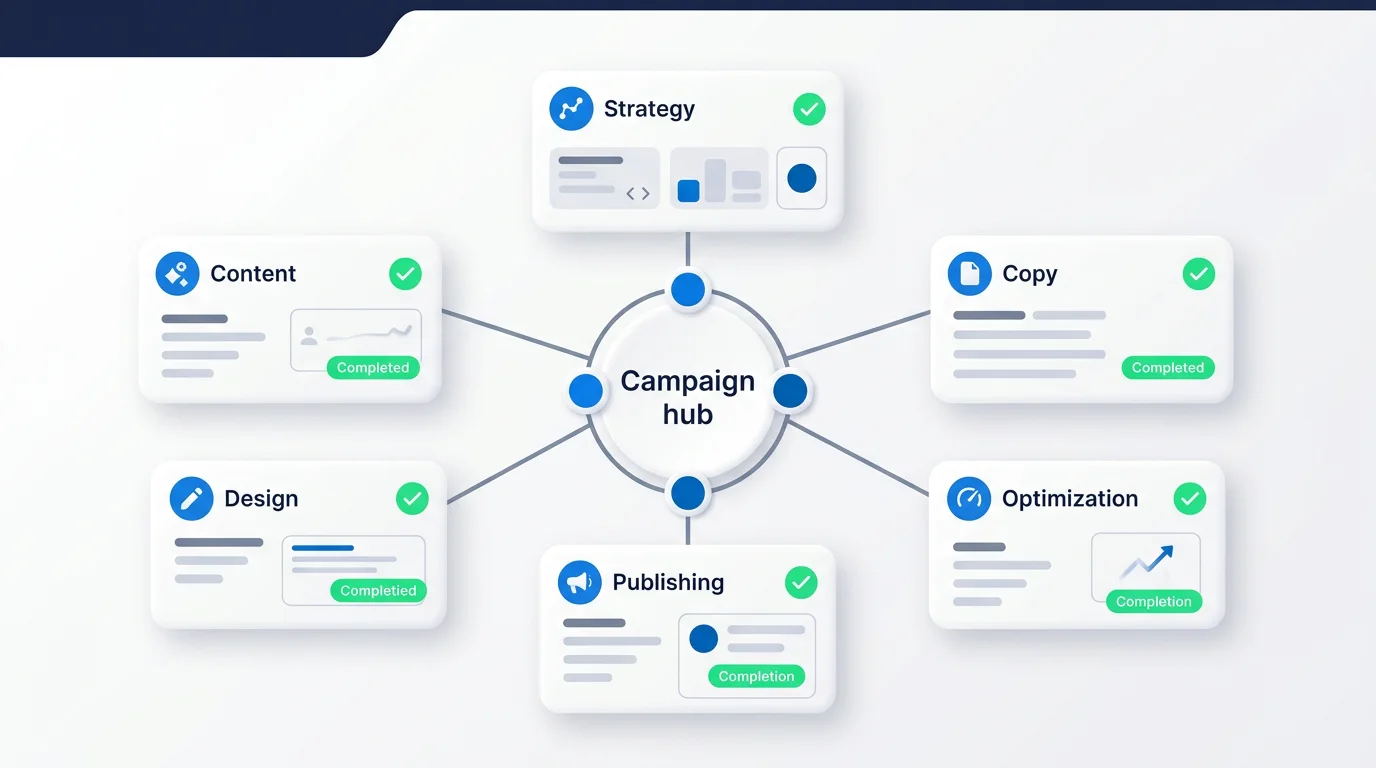
Moving to an orchestrated AI platform isn't just about saving a few hours; it fundamentally shifts the economics of SaaS marketing. First, there is the immediate reduction in software licensing costs. By consolidating your page builder, form software, email marketing platform, and ad generation tools into a single environment like Superpage, teams can trim thousands of dollars in monthly SaaS overhead.
More importantly, the "time-to-launch" metric shrinks from weeks to minutes. Demand generation agencies and lean marketing teams can spin up vertical-specific solution pages on the fly, testing new markets and keyword sets without waiting on engineering or design bottlenecks.
Deepening the ROI: Hard Metrics and Structural Cost Reductions
Let us look at the hard metrics. A typical B2B SaaS startup scaling its demand generation efforts usually pays a baseline of $150/month for a dedicated landing page builder, $150/month for marketing automation, $70/month for middleware routing, and upwards of $5,000/month if relying on external agencies for copy and ad creative. That is a substantial burn rate just to maintain the infrastructure required to launch campaigns.
By transitioning to an integrated AI agent platform, you eliminate these overlapping subscriptions. But the structural cost reduction goes deeper than SaaS licensing. The most expensive hidden cost in SaaS marketing is the "Opportunity Cost of Slow Go-To-Market (GTM)."
If a competitor launches a new integration and you need four weeks to wireframe, write, design, and deploy a counter-campaign, you lose a month of potential pipeline. With true AI orchestration, you can launch a dedicated comparison page, complete with a qualification form and perfectly matched retargeting ads, before the competitor's press release even finishes circulating. Speed transforms from an operational metric into pure top-line revenue growth.
Your AI Marketing Automation Checklist
If you are evaluating AI tools to speed up your SaaS marketing and pipeline generation, do not settle for a basic text generator masking as an automation tool. Look for solutions that actually reduce your operational workload. Use this practical checklist when vetting platforms:
-
True End-to-End Execution Does the tool just give you text to copy-paste, or does it actually generate the deployable page, the forms, and the emails natively?
-
Cross-Channel Contextual Awareness Do the automated emails and ads automatically align with the landing page messaging without requiring you to manually feed it prompt history?
-
Agility and Iteration Speed If you change your target audience from "startup founders" to "enterprise CMOs," does the entire campaign (ads, pages, emails) update instantly, or do you have to rewrite every asset one by one?
-
Meaningful Stack Reduction Can this platform legitimately replace your fragmented landing page builder, form router, and email marketing tools?
-
Integrated Payments and Checkout If the goal is direct revenue generation, does the tool offer seamless checkout and payment functionality built into the funnel?
The competitive edge in SaaS marketing no longer belongs to the team with the largest budget or the most complex tech stack. It belongs to the operator who can move from an idea to a fully launched, cohesive campaign in a matter of minutes. By shifting from disjointed prompt wrappers to coordinated AI agents, SaaS teams can finally unlock the execution speed required to dominate their markets.
Frequently Asked Questions About SaaS Marketing AI
How do AI agents differ from prompt-based tools like ChatGPT?
Prompt-based tools are passive; they wait for you to ask a question and return a text response. You must still copy, format, and deploy that text manually. AI marketing agents are active and specialized. They share context and collaborate to automatically build the final asset—whether that is deploying the live landing page, wiring the data logic in a form, or setting up the email trigger—without manual intervention.
Can AI handle complex B2B SaaS lead routing?
Yes. A consolidated AI platform integrates forms and qualification natively. You can instruct the system to route leads dynamically based on company size, budget, or custom industry questions, sending high-value prospects directly to sales calendars while funneling smaller accounts to a self-serve checkout.
Will the AI match my existing SaaS brand voice and design language?
Absolutely. AI agents utilize global brand settings, ingesting your specific tone guidelines, color palettes, typography preferences, and target audience definitions. This ensures every page, email, and ad produced feels authentic and consistent with your core brand identity.
Does this replace my existing marketing team?
No, it empowers them. Instead of your talented demand generation managers and product marketers wasting hours adjusting HTML blocks or fixing broken Zapier webhooks, they act as strategic operators. They direct the AI agents, test more markets, and focus entirely on high-level growth strategy rather than tedious execution.
How does this impact search engine visibility and SEO?
Because the AI agents deploy code that is structurally sound, mobile-responsive, and fast-loading, the underlying technical SEO is pristine. Furthermore, you can instruct the copywriting agents to optimize for specific long-tail SaaS keywords natively during the generation process, ensuring your landing pages rank well organically.