

You have a high-impact campaign idea. The strategy is sharp, the targeting is dialed in, and the core messaging is mapped out. But by the time the campaign actually goes live, weeks have passed. The momentum is gone, the sales team is impatient, and your competitors are already running similar messaging.
Why does this happen? Because SaaS marketers are trapped in a fragmented assembly line. When landing pages, automated emails, and paid ads are built in entirely separate systems, execution slows to a crawl. The delay between "idea" and "live campaign" rarely comes down to a lack of effort—it comes down to the operational friction of your marketing stack.
Speed isn't just a vanity metric in SaaS marketing; it is the fundamental driver of iteration, learning, and revenue growth. In this playbook, we break down why traditional campaign execution is failing early-stage B2B SaaS teams and how you can transition to a coordinated, agent-driven workflow to launch complete campaigns in minutes.
Key Takeaways
- The handoff tax is killing your speed: Moving copy and assets between disconnected tools multiplies your time-to-market.
- Sequential execution is outdated: You no longer need to wait for the landing page to be finished before building the email sequence and ad creatives.
- Speed to learning equals lower CAC: Launching bi-weekly instead of quarterly gives you 6x more data points to optimize acquisition costs.
- AI Agents replace the prompt chain: True automation coordinates specialists (design, copy, ops) to output a unified funnel natively.
Diagnosing the Campaign Launch Bottleneck
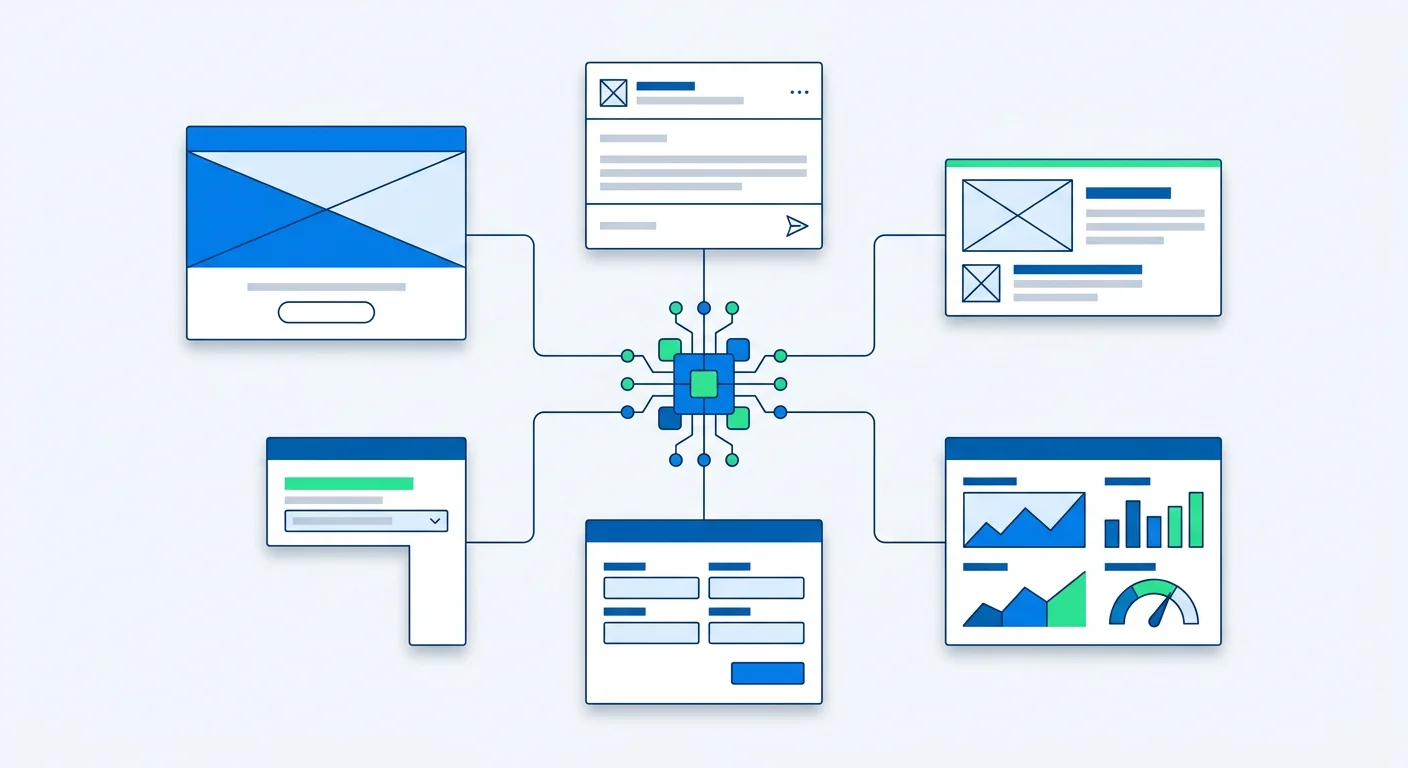
The average SaaS marketing team uses a landing page builder, an email marketing platform, a CRM, a design tool, and multiple advertising networks. This "best-of-breed" approach was supposed to give marketers ultimate flexibility. Instead, it created an operational nightmare known as the handoff tax.
Every time an asset moves from one platform to another, or from one team member to another, friction is introduced. If your launches are stalling, you are likely suffering from one or more of these common operational bottlenecks:
- Siloed Copy Handoffs: Moving copy from a Google Doc to a CMS, then rewriting it for your email platform, and summarizing it for Meta Ads creates massive version-control headaches and breaks message consistency.
- The Design Waitlist: Marketers are forced to wait in the design queue for simple landing page graphics or ad creatives, turning a one-day execution task into a two-week delay.
- Disconnected Integrations: Your landing page builder doesn't natively talk to your email platform. Building automated sequences becomes a manual chore of API keys, Zapier webhooks, and field mapping.
The Math Behind Campaign Velocity
Why does launching faster actually matter? It all comes down to the concept of Speed to Learning.
Once your campaign is live, the focus shifts from execution to iteration. This is where launch speed translates directly into a mathematical competitive advantage. If your current workflow allows you to launch one major campaign per quarter, you get exactly four "learning moments" per year. If a streamlined workflow allows you to launch bi-weekly, you get twenty-six learning moments.
Higher learning velocity means you optimize your Customer Acquisition Cost (CAC) faster, find winning messaging combinations quicker, and respond to market shifts before your competitors even finish their internal alignment meetings. In modern SaaS, perfection is the enemy of profitability; iteration is what drives revenue.
"In B2B SaaS marketing, the team that tests the fastest usually wins. You cannot test fast if your marketing stack forces you to build slow."
The AI-Powered SaaS Campaign Launch Playbook
To reduce your launch time without sacrificing quality, you need to rethink your operational sequence. Moving from a sequential workflow to a concurrent, unified workflow is the key. Here is a practical 5-step playbook for executing faster using coordinated AI agents.
Step 1: Centralize Your Campaign Brief
Stop writing separate briefs for ads, emails, and landing pages. In a fragmented system, the ad copywriter interprets the brief differently than the landing page designer, leading to a disconnected user journey.
Instead, create a single, unified master brief that clearly defines the target audience, the core value proposition, the primary pain point, and the single call-to-action (CTA). When you use a platform like Superpage, this single brief acts as the directive for all AI marketing agents simultaneously. Every asset—from the top-of-funnel ad to the bottom-of-funnel email—flows from this exact, centralized context.
Step 2: Execute Concurrently, Not Sequentially
The traditional marketing timeline looks like this: write copy (Week 1), design page (Week 2), build page (Week 3), write emails (Week 4), design ads (Week 5). You are forced to work sequentially because humans and disparate tools require handoffs.
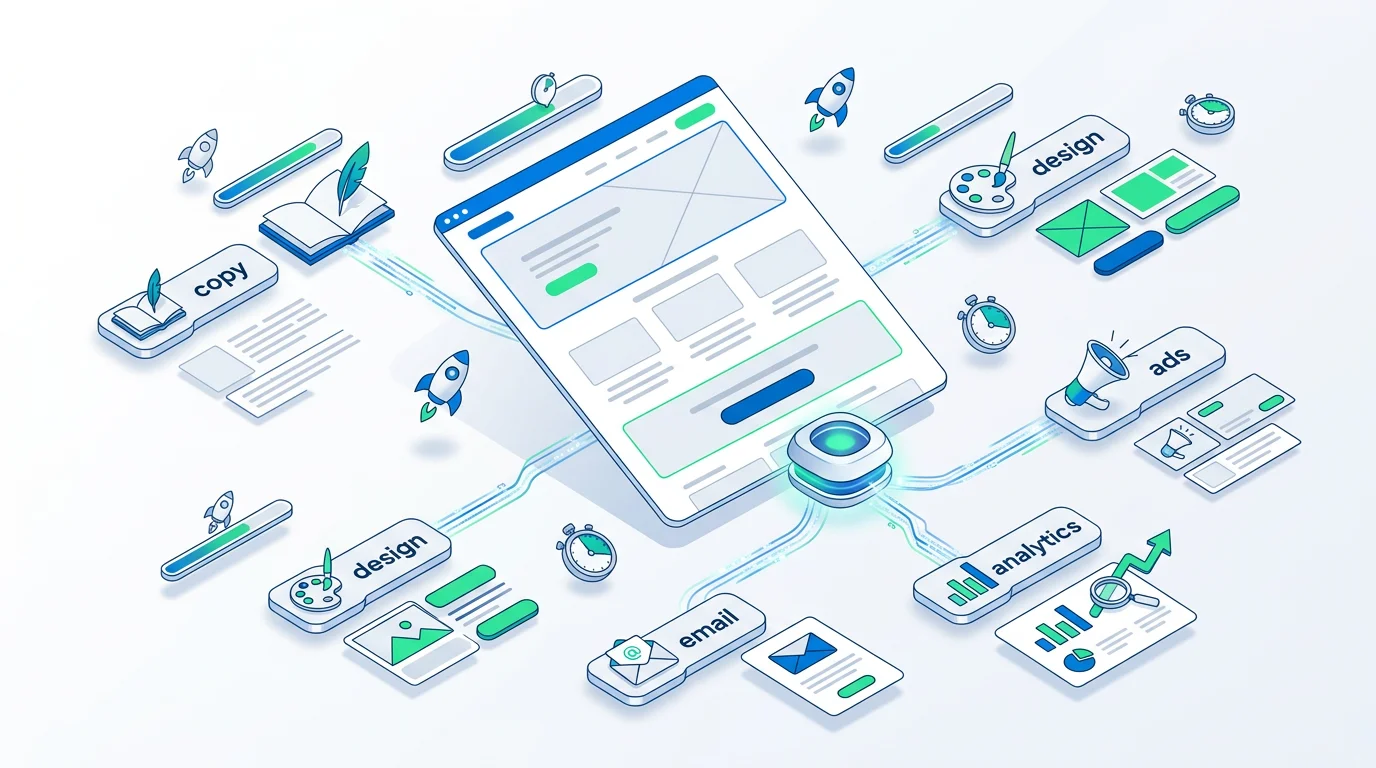
By transitioning to a unified platform with coordinated AI specialists, you can generate the landing page layout, write the email nurture sequence, and draft the ad variations at the exact same time.
Step 3: Automate Lead Routing and Qualification
Building the assets is only half the battle. Connecting them is where many campaigns break down. Manually mapping form fields to your CRM, setting up hidden UTM trackers, and ensuring the right email triggers fire requires meticulous, error-prone work.
In a modern playbook, lead routing is native to the campaign. Using integrated forms and qualification logic inside a single platform means that the moment a user submits their information, the data is instantly validated, and the automated follow-up sequence begins—no Zapier troubleshooting required.
Step 4: Unify Your QA Process
Friction peaks during Quality Assurance (QA). When assets live in different platforms, marketers have to jump between tabs to verify tracking links, check mobile responsiveness, send test emails, and ensure messaging alignment.
A single-platform approach means one QA pass covers the entire campaign journey. You can review the Meta Ad, click through to the landing page, fill out the form, and instantly review the auto-responder email—all within the same interface. This cuts QA time from days to minutes and drastically reduces the chance of a broken link going live to paid traffic.
Step 5: Rapid Iteration and Scaling
Once the campaign is live, the data will tell you what needs to change. Perhaps the hook in your Meta Advertising is converting cheaply, but the landing page is bouncing traffic. In a fragmented stack, fixing this requires going back through the entire multi-tool process.
With AI marketing agents, you simply provide a strategic directive: "The ads are bringing in early-stage founders, but the page feels too enterprise. Adjust the landing page copy to speak to seed-stage pain points." The agent handles the structural and copy updates instantly, keeping your learning loop tight and uninterrupted.
Why Coordinated Agents Beat ChatGPT Prompts
Many teams try to speed up their workflow by using generic AI chatbots to write copy. While this helps draft text faster, it doesn't solve the core operational bottleneck. You still have to copy-paste that text into Webflow, format it, build the Marketo email, and set up the Facebook Ad manager.
Marketing built by agents—not prompts—changes the paradigm.
Instead of acting as an advanced typewriter, a platform like Superpage acts as your execution team. Coordinated AI specialists plan, design, write, and connect the assets of your campaign. They understand the relationship between the ad headline and the form confirmation email. They replace multiple point solutions with one system, allowing revenue-focused operators to move from idea to launch without handoffs.
The Shift: Sequential vs. Coordinated Execution
To fully understand the handoff tax, we must look deeply at how campaigns are built today versus how they should be built. Sequential execution relies heavily on a chain of human and software dependencies. If the copywriter is delayed, the designer cannot start. If the designer is delayed, the developer cannot build the landing page. If the landing page isn't built, the marketing operations manager cannot set up the automated emails and form routing. The entire launch is held hostage by the slowest step in the chain.
Coordinated execution, powered by AI marketing automation for SaaS, destroys this dependency chain. It allows all assets to be generated simultaneously from a single strategic source. Because the intelligence layer sits across the entire stack, the ad creative, landing page copy, and email sequences are built concurrently, natively aware of one another.
| Campaign Phase | Sequential (Fragmented Stack) | Coordinated (Agent-Driven) |
|---|---|---|
| Strategy & Briefing | Multiple separate briefs created for copywriters, designers, and ad managers. Prone to misinterpretation. | One centralized strategic directive. All agents pull from the exact same master context simultaneously. |
| Asset Creation | Step-by-step handoffs. Copy is written, then passed to design, then to web dev, then to email ops. (Timeline: Weeks) | Concurrent generation. Pages, emails, and ads are built at the exact same moment. (Timeline: Minutes) |
| Integration & Routing | Manual API connections via Zapier. Forms mapped field-by-field. High risk of data leaks and broken webhooks. | Native routing. Forms, CRM, and email sequences are built on the same infrastructure, instantly connected. |
| QA & Review | Jumping across 5+ tabs (Webflow, Marketo, Meta Ads) to verify links and message consistency. | Unified QA environment. Review the entire user journey from click to conversion in a single dashboard. |
| Iteration & Optimization | Slow adjustments. Changing an angle requires updating the ad, the page, and the email separately. | Global updates. Adjust the strategy in the master brief, and all connected assets update their messaging automatically. |
Real-World SaaS Campaign Examples
When you replace your fragmented marketing stack with a unified platform, the types of campaigns you can run multiply exponentially. You are no longer constrained by the operational burden of creating the assets. Let's look at three specific examples of how modern SaaS teams leverage coordinated execution to outmaneuver their competitors.
Example 1: The Rapid Competitor Intercept
Imagine a primary competitor in your space experiences a massive, multi-day server outage or abruptly announces a highly unpopular pricing tier change. In a traditional marketing environment, capitalizing on this timely event would be nearly impossible. It would require days of rushed coordination to write a new "Competitor Alternative" landing page, get it designed, set up targeted Google Search Ads, and trigger an appropriate email sequence. By the time it goes live, the news cycle has moved on.
With coordinated AI marketing agents, a SaaS marketing team can deploy a full intercept campaign in under thirty minutes. The master brief dictates the core angle: "Competitor X is down again. Switch to our platform for 99.99% guaranteed uptime and seamless migration." The agents instantly generate a high-converting comparison landing page, draft the localized Google Ad copy targeting the competitor's branded keywords, and structure the follow-up drip campaign offering a white-glove onboarding experience.
Example 2: The Hyper-Segmented Vertical Rollout
Most SaaS companies sell to multiple verticals—for instance, serving both healthcare providers and financial services firms. However, because creating tailored campaigns is so time-consuming, marketers often settle for generic messaging that attempts to speak to everyone (and ultimately converts no one).
By utilizing an agent-driven platform, teams can clone their core campaign architecture and instantly rewrite it for ten different distinct verticals. The financial services version will automatically adjust its imagery, compliance-focused copywriting, and specific case studies, while the healthcare version pivots to highlight patient data security and HIPAA compliance. This level of personalization drastically reduces Customer Acquisition Cost (CAC) without requiring a tenfold increase in human workload.
Example 3: The Feature Adoption Nurture
Marketing isn't just about net-new acquisition; it is equally critical for customer marketing and feature adoption. When the product team releases a highly anticipated integration, the marketing team needs to ensure existing users actually adopt it to drive retention.
Instead of a single, boring product update email, the marketing team can quickly spin up a comprehensive adoption campaign. This includes an in-depth feature landing page, a multi-step email nurture educating users on the new workflow, and targeted retargeting ads aimed only at existing active users. Coordinating these touches seamlessly ensures higher engagement rates and immediately showcases the ROI of the product team's hard work.
The Ultimate SaaS Campaign Launch Checklist
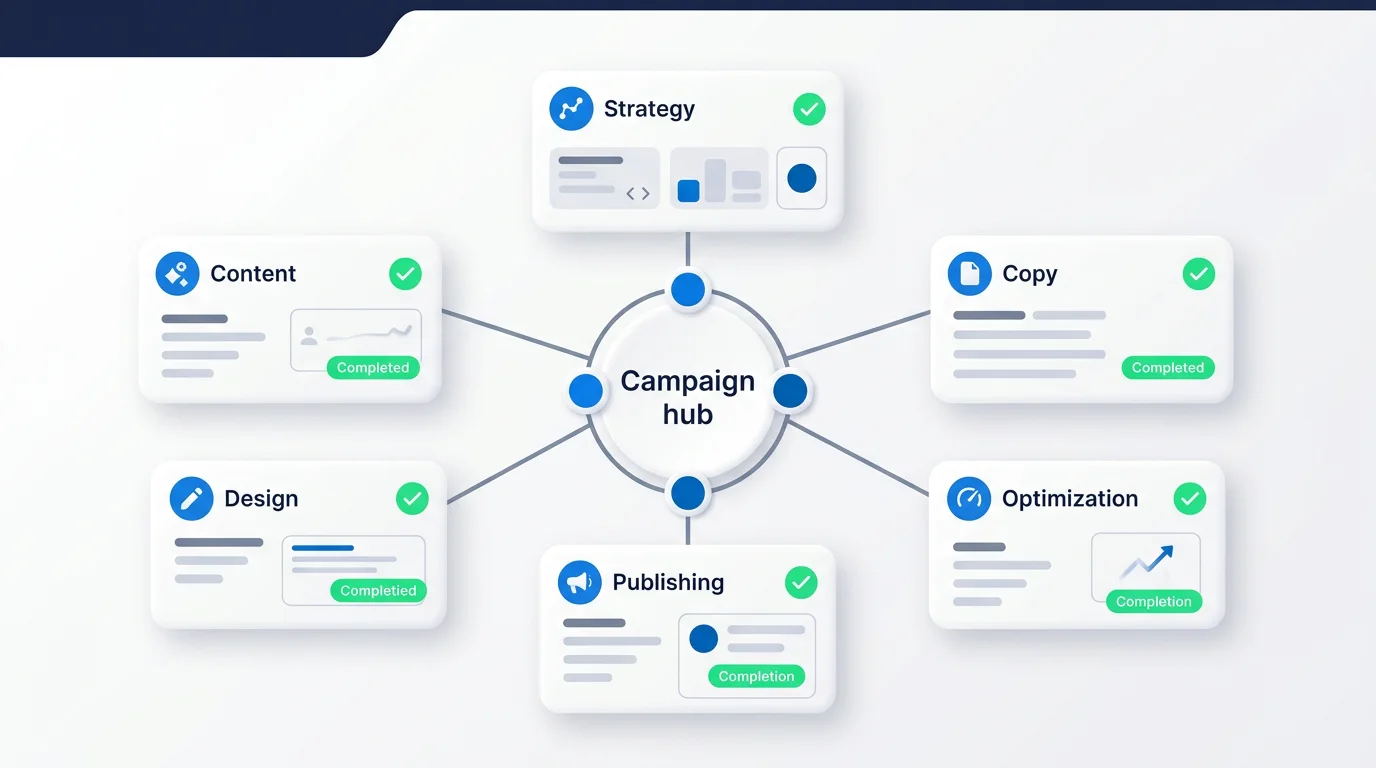
Even with the fastest tools in the world, a lack of strategic oversight can cause campaigns to falter. Before you click "publish" and drive paid or organic traffic, run through this comprehensive checklist designed specifically for high-velocity SaaS marketing teams. This ensures that speed never comes at the cost of precision.
1. Unified Strategic Directive Confirmed
Ensure your core brief contains a singular, undeniable value proposition. Have you clearly identified the specific persona, their immediate pain point, and the single action you want them to take? Vagueness here will cascade into confused AI generation and weak copy.
2. Message Match Across All Touchpoints
Verify that the headline on your landing page perfectly mirrors the hook used in your top-of-funnel ads. If the ad promises "Cut API integration time in half," the landing page must immediately reinforce that exact claim, not pivot to a generic "Welcome to our platform" message.
3. Form Routing and Lead Qualification Tested
Submit a test lead through your live form. Does the routing logic work correctly? If a lead marks themselves as "Enterprise (1000+ employees)," are they properly fast-tracked to your sales team's calendar instead of being placed in a generic self-serve nurture track?
4. Auto-Responder Delivery Verified
Check the immediate follow-up email. Does it arrive within seconds of the form submission? Does it deliver the promised lead magnet, webinar link, or calendar booking, and is it sent from a trusted, authenticated domain to ensure high deliverability?
5. Analytics and Conversion Tracking Active
Ensure the Meta Pixel, Google tag, or your primary analytics tracking scripts are firing correctly on the confirmation page. Accurate conversion attribution is essential to letting algorithms optimize your ad spend effectively in the first 48 hours.
6. Mobile Responsiveness Checked
With a significant portion of B2B research happening on mobile devices, visually review the landing page on a smartphone viewport. Are the CTA buttons easily clickable? Is the form too long for a mobile screen? Ensure the experience is entirely frictionless.
7. Nurture Sequence Timing Calibrated
Review the delays between the emails in your automated drip sequence. Sending three emails within the first 24 hours can cause immediate unsubscribes. Ensure the cadence is respectful, value-driven, and naturally leads the prospect toward booking a demo or starting a trial.
Frequently Asked Questions
As SaaS teams transition from fragmented stacks to unified platforms running automated marketing campaigns, common questions arise around control, quality, and implementation. Here are the answers to the most frequent concerns.
If AI builds the campaign, do I lose control over my brand voice?
Not at all. The shift to AI agents isn't about surrendering control; it's about amplifying your directives. When you set up your master brief, you define the exact tone, terminology, and brand constraints. The agents act as an incredibly fast execution team that rigorously adheres to your specific brand guidelines, ensuring the output sounds exactly like your company, not a generic robot.
Does concurrent execution mean I can't review individual assets?
You retain full editorial oversight. Concurrent execution simply means the assets are generated simultaneously to save weeks of waiting. Once the draft campaign is ready, you enter a unified QA environment. You can click into the landing page text, tweak the ad headline, or adjust the email copy manually before anything goes live. It gives you a complete 95% starting point, leaving the final 5% of polish in your hands.
How does this integrate with my existing CRM like Salesforce or HubSpot?
A unified marketing platform handles the top and middle of the funnel—ads, pages, forms, and initial nurturing. When a lead hits the qualification threshold you set (such as booking a demo or hitting a specific lead score), the platform natively pushes that enriched, qualified lead directly into your CRM. You don't replace your CRM; you replace the chaotic web of landing page builders and Zapier webhooks that feed into it.
Is this suitable for Enterprise SaaS with long sales cycles?
Absolutely. In fact, long sales cycles require more sophisticated, persistent nurturing. Being able to quickly spin up hyper-targeted account-based marketing (ABM) campaigns, complete with dedicated landing pages and personalized email sequences for specific high-value accounts, is a massive advantage in enterprise sales. Speed to market matters just as much when you are hunting whales as when you are capturing self-serve users.
The Bottom Line
To win in today's B2B SaaS landscape, you cannot afford a six-week launch cycle. By centralizing your marketing stack and leveraging coordinated AI agents, you eliminate the operational friction holding your campaigns back. Launch faster, test more frequently, and let speed become your ultimate competitive moat.