

For the past year, marketing teams have treated AI like a superpowered intern. You give it a highly specific task—write this promotional email, draft this Facebook ad copy, outline this landing page—and it gives you raw materials back. But raw materials don't generate revenue. Live, fully connected campaigns do.
The bottleneck in modern marketing is no longer generating text. Writing an email takes seconds. Generating an image takes a fraction of a minute. The real friction lies in the assembly. It’s stitching together copy, design, routing logic, backend tracking, and triggered responses across a heavily fragmented stack of tools to turn those isolated, raw materials into a cohesive, conversion-ready asset. The cost of this friction is immense: delayed launches, exhausted teams, and disjointed customer experiences.
As the landscape of marketing technology evolves, so does the capability of artificial intelligence. We are moving rapidly past the era of the isolated drafting assistant and entering the era of execution. Instead of manual setup, growth teams can now launch automated marketing campaigns that are concepted, built, and deployed entirely by autonomous systems.
Enter AI marketing agents. As the industry transitions from simple generative prompts to autonomous action, marketing agents are emerging as the ultimate solution to the assembly bottleneck. But what exactly are they, how do they fundamentally differ from the standard chatbots we’re used to, and how are modern revenue teams using them to replace their entire marketing stack?
Key Takeaways
- Generative AI vs. Agentic AI: Chatbots require step-by-step prompting and manual intervention; agents take a strategic goal and autonomously execute the multi-step, cross-functional workflows required to achieve it.
- The Prompt Chaining Trap: Relying on standard AI tools forces marketers into a grueling copy-paste loop, acting as human middleware to manually move AI-generated assets into page builders, email platforms, and ad managers.
- Coordinated Specialists: The most effective AI marketing platforms use distinct, specialized agents (strategy, copy, design, automation) working together in tandem, rather than relying on a single, generalized model to do everything.
- Tech Stack Consolidation: By integrating native functionality directly into the AI's environment, agents can replace disjointed point solutions, allowing teams to launch end-to-end campaigns in minutes instead of weeks.
What Are AI Marketing Agents?
To truly understand what an AI marketing agent is, we must first unlearn what traditional software automation and standard generative AI have taught us. We have been conditioned to treat AI as an answering machine: we ask a question, and it provides an answer.
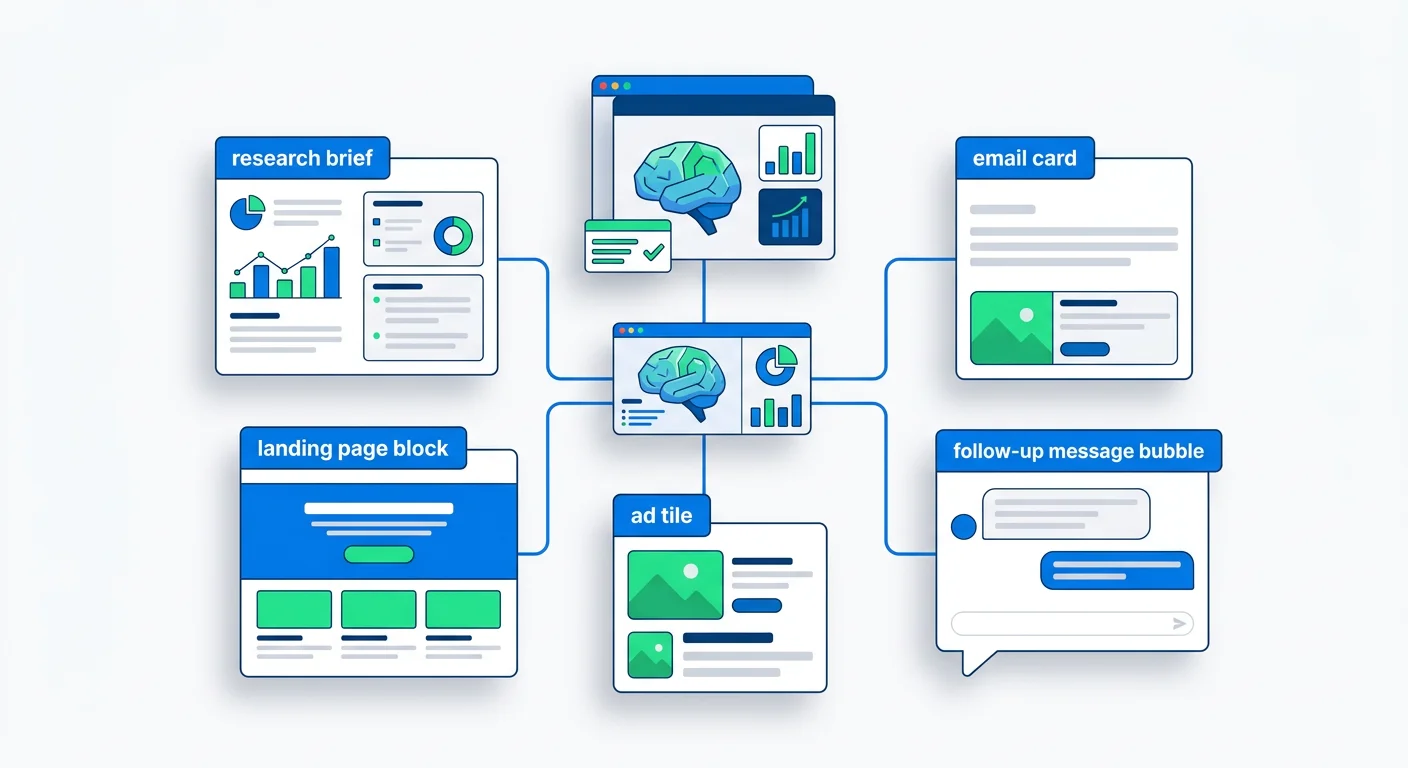
Unlike a standard chatbot that responds to a single, isolated prompt, an AI marketing agent is an autonomous piece of software designed to execute multi-step, goal-oriented workflows. An agent doesn't just return words on a screen; it holds persistent context, plans a strategic approach, utilizes external tools, structures data, and actively builds the functional assets required to hit a desired metric.
Think of it as the difference between a word processor and an entire publishing house. Prompt-based tools give you the words. Traditional automation platforms (like Zapier or Make) move data rigidly from Point A to Point B based on strict, unforgiving trigger-action rules. AI marketing agents sit above both: they dynamically determine what needs to be written, how it should be designed visually, where the data should go, and when follow-ups should occur, adapting on the fly based on the overarching goal.
An agentic system can recognize when a piece of copy is too long for a specific mobile design component and automatically rewrite it to fit. It can see that a lead capture form requires a specific qualification step and proactively build the branching logic to support it. It operates with a level of environmental awareness that raw language models simply do not possess.
Agents vs. Chatbots vs. Workflow Automation
The terminology around artificial intelligence is notoriously muddy. Many platforms slap the word "Agent" on a basic chatbot interface. To clarify the distinction, let's break down how AI marketing agents compare to standard chatbots and traditional workflow automation.
| Capability | Standard Chatbots (e.g., ChatGPT) | Workflow Automation (e.g., Zapier) | AI Marketing Agents |
|---|---|---|---|
| Core Function | Text & media generation based on immediate prompts. | Moving structured data between existing applications. | Autonomous planning, creation, and deployment of assets. |
| Context Memory | Limited to the current chat session or thread. | None. Operates strictly on deterministic rules. | Persistent across the entire campaign ecosystem and account history. |
| Adaptability | High for text, but zero for functional layout or logic. | Breaks immediately if API formatting changes. | Self-correcting. Modifies copy and design to fit strategic parameters. |
| Human Intervention | Requires constant prompting and manual assembly. | Requires complex upfront mapping and manual maintenance. | Requires high-level strategic direction; handles the execution autonomously. |
The Problem with Prompt-Based AI
If your team relies heavily on traditional generative tools to run campaigns, you are almost certainly feeling the friction of "prompt chaining." This is the exhausting, manual process of acting as the human middleware between the AI generating the content and your actual marketing stack where the content lives.
Let's look at a typical campaign launch workflow using standard generative AI. You may recognize this painful cycle:
- You open a chatbot and ask for a strategic angle for a new product landing page.
- You ask it to write the headline, subheadline, and hero copy.
- You prompt it again for the body copy, feature breakdowns, social proof sections, and FAQs.
- The manual switch: You take that raw text, open your CMS or page builder, and manually attempt to paste the text into a rigid, pre-existing design template.
- You quickly realize the copy is far too long for the design cards, breaking the layout. So, you go back to the chatbot and ask it to shorten the text by 50%.
- You open a separate image generation tool, prompt it for hero visuals, download the files, compress them, and upload them to your CMS.
- You prompt the original chatbot for a 3-part follow-up email sequence and a corresponding Facebook ad campaign to drive initial traffic.
- You manually copy those emails, paste them into your CRM, build the automation triggers by hand, and load the ad copy into Meta Business Manager.
In this scenario, you haven't actually automated your marketing. You have simply outsourced the first draft of the copy. You are still acting as the project manager, the developer, the designer, and the data entry clerk, moving disjointed text manually between disconnected silos.
Worse, you suffer from severe context degradation. The AI writing your Meta ads often loses the subtle positioning nuances of the landing page you built two days ago. The tone of the email sequence doesn't quite match the checkout page. Going from an approved concept to a live, functioning URL still takes days of manual assembly, formatting, responsive design checks, and bug fixes.
"Marketing is built by agents—not prompts. The true value of AI isn't in generating better drafts; it's in replacing your entire fragmented marketing stack with one cohesive, autonomous engine."
Coordinated Agents vs. Single Chatbots
This is where agentic marketing completely changes the paradigm. At Superpage, we fundamentally believe high-performance marketing shouldn't be built by a single omnipotent chatbot. A generalized model trying to act as a copywriter, a web designer, a media buyer, and a data engineer simultaneously will inevitably produce average, generic results in all four disciplines.
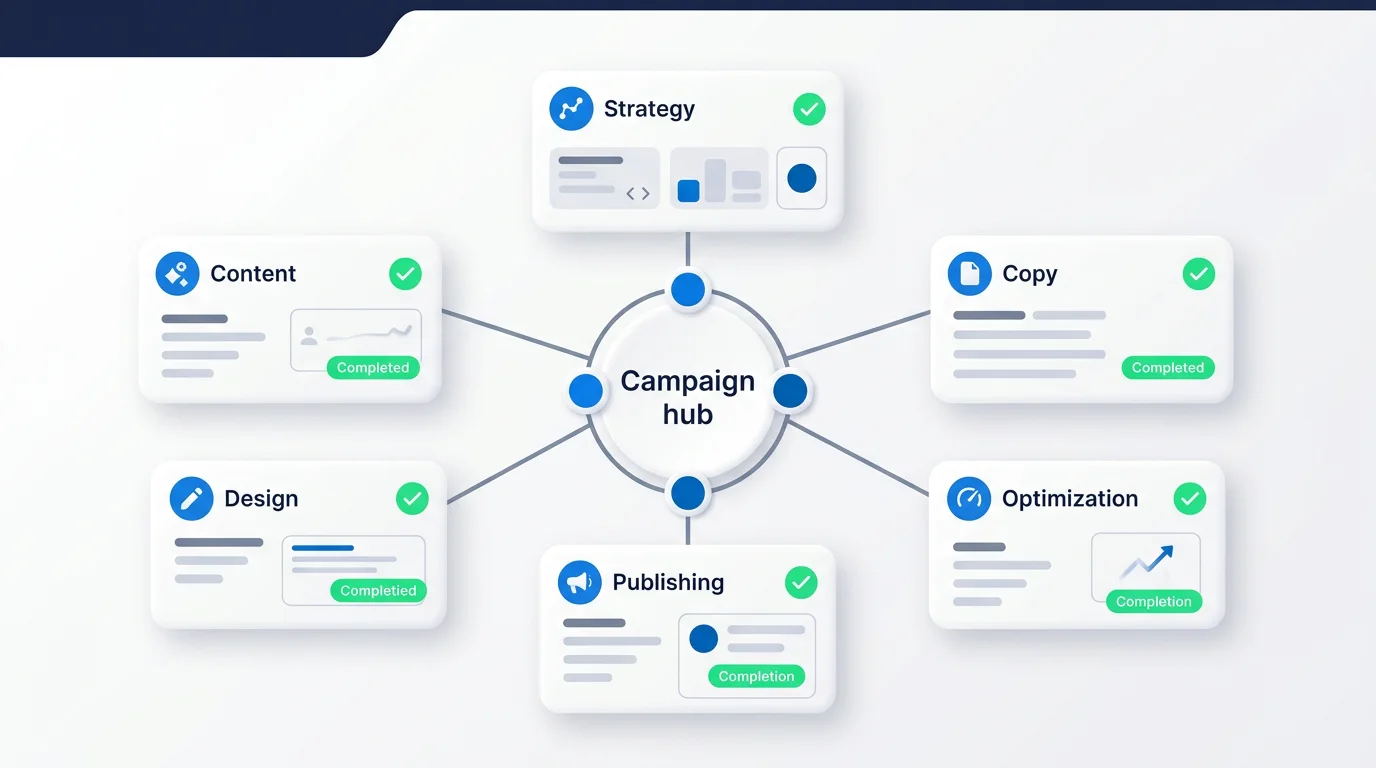
Instead, professional-grade campaigns require a team of coordinated AI specialists. Just as a real-world agency assigns distinct roles to experts who collaborate on a shared goal, an agentic platform utilizes specialized models trained deeply on specific functional tasks.
When you initiate a campaign build on an agentic platform, you are simply setting a high-level goal (e.g., "Launch a lead generation campaign targeting enterprise CTOs for our new cloud security feature"). Behind the scenes, the specialized agents take over the execution:
Strategy Agent
Defines the positioning and angle. Analyzes the target audience, identifies core pain points, reviews historical campaign data, and outlines the entire conversion journey before a single word is written.
Copy Agent
Takes the strategic brief and generates high-converting text tailored for specific placements. It ensures that headers, body paragraphs, button CTAs, and email subject lines are perfectly aligned in tone and length.
Design Agent
Structures the visual layout dynamically. Using an advanced AI funnel builder, it doesn't force copy into rigid templates; it builds custom, responsive pages and funnels that highlight the message naturally.
Automation Agent
Wires up the critical backend infrastructure. It configures the forms, qualification logic, lead routing, and triggers the necessary follow-up sequences automatically, without requiring a single Zapier integration.
Because these agents operate within the same unified environment, they possess the ability to review each other's work. If the Design Agent realizes a specific features section needs more text to balance the visual weight of the page, it signals the Copy Agent to adjust and expand the paragraph. This bi-directional communication ensures they maintain perfect consistency from the first ad impression, through the landing page, and all the way to the final checkout or demo request.
How Revenue-Focused Teams Use Agentic Marketing
The shift from prompt chaining to agentic orchestration isn't just a technical upgrade; it's a structural advantage. Speed of execution is the defining metric for modern growth teams. If you can test five campaigns in the time it takes your competitor to launch one, you will inevitably find the winning combination first. Here is how different verticals are deploying coordinated AI agents to capture market share.
1. B2B SaaS: Scaling Demo Acquisition
For B2B SaaS companies, generic homepages are conversion killers. Different buyers have vastly different pain points. A CTO cares about data security, compliance, and infrastructure integration; a CMO cares about attribution tracking, ease of use, and ROI.
Using AI marketing agents, growth teams can instantly spin up dedicated, highly-targeted funnels for every unique buyer persona. You simply instruct the platform: "Build a demo-request campaign targeting enterprise CMOs migrating from legacy analytics platforms." Within minutes, the platform generates the tailored landing page, the specific form qualification logic (e.g., routing companies with over 500 employees to an enterprise account executive instantly), and the automated follow-up email sequence. This makes AI marketing automation for SaaS an absolute necessity. What used to take two weeks of cross-departmental coordination now takes five minutes.
2. Demand Generation Agencies: Eliminating the Handoff
Agencies suffer immensely from margin compression due to the sheer human overhead required to launch a client campaign. The account strategist briefs the copywriter, who then hands the document off to the designer, who builds mockups and hands off to the developer, who finally integrates with the client's marketing automation platform. Every handoff introduces delays, miscommunications, and billable hours.
With an agent-driven workflow, lead generation agencies can completely collapse these handoffs. The agency's unique strategic inputs and client understanding guide the agents, but the AI handles the heavy lifting of assembly. This allows a lean team to launch multi-channel campaigns for ten clients in the time it previously took to launch one, drastically improving unit economics without sacrificing the quality of the final deliverable.
3. E-commerce & Direct-to-Consumer (D2C): Rapid Testing
In e-commerce, the winner is usually the brand that tests the most angles, offers, and creatives. Did a new TikTok trend suddenly emerge? You need a landing page live today, not next week.
AI agents allow e-commerce brands to launch dedicated product drops, influencer-specific landing pages, or flash sale funnels instantly. Because the agents also handle backend integrations, they can wire up the checkout flows, upsell steps, and payment systems simultaneously, allowing the brand to move from an idea to active revenue capture in a single afternoon.
Implementation Workflow: How to Deploy AI Agents
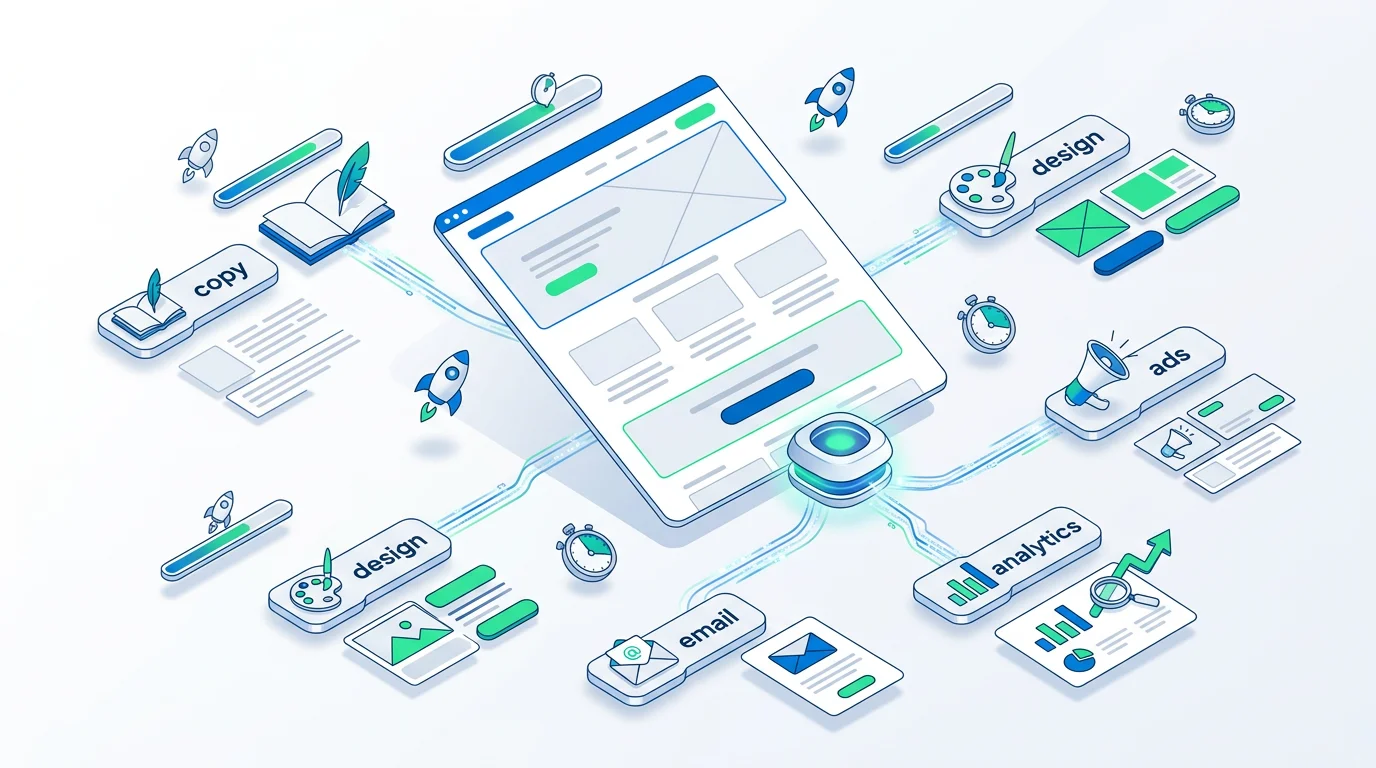
Transitioning from manual workflows to an agentic system might sound complex, but the implementation is designed to be seamless. Because the agents handle the integration internally, the user's focus shifts from technical setup to strategic oversight. Here is the standard implementation workflow for deploying an AI agent campaign:
- Define the Strategic Parameter: You start by providing the foundational context. Who are you targeting? What is the core offer? What is the conversion goal (e.g., booked call, lead capture, direct sale)? The Strategy Agent analyzes this input to form a cohesive campaign plan.
- Agent Orchestration: Once approved, the platform parallelizes the work. The Copy Agent drafts the assets while the Design Agent structures the pages. You watch as the funnel takes shape in real-time, fully branded to your company guidelines.
- Review and Direct: Instead of writing from scratch, your role becomes editorial. If a section doesn't feel right, you don't rewrite it manually—you give feedback to the agent. "Make the pricing section feel more premium," or "Add a technical FAQ for developers." The agents adjust instantly across all connected assets.
- Launch and Monitor: The Automation Agent secures the backend, ensuring forms route to the correct CRM pipelines and follow-up emails trigger appropriately. You click publish, and the campaign is live, fully instrumented for tracking and optimization.
Frequently Asked Questions
Will AI agents replace my marketing team?
No. Agents replace the tedious, manual assembly work that bogs your team down. By automating the integration of copy, design, and logic, your marketers are freed up to focus on strategy, positioning, offer creation, and analyzing customer insights—the high-leverage work that actually drives growth.
How long does it take to deploy a full campaign?
With standard prompt-chaining and manual tools, a multi-channel campaign can take weeks. With coordinated AI agents on a platform like Superpage, you can go from a blank screen to a live, functional funnel with forms, emails, and tracking in under 15 minutes.
Do I need technical or coding skills?
Absolutely not. The primary benefit of agentic architecture is that the AI handles the code, the layout, and the integrations. If you can articulate your marketing strategy and target audience, the agents will handle the technical execution.
Replacing the Fragmented Tech Stack
The most profound impact of AI marketing agents isn't just speed; it's total platform consolidation. Over the past decade, marketing technology has become absurdly bloated. You pay for a landing page builder, an email marketing tool, a form builder, a workflow automation tool, and now, three different AI generative subscriptions.
The fatal flaw in this fragmented model is data isolation. When your tools are disconnected, your data is disconnected, and the AI cannot make intelligent, holistic decisions. A prompt-based AI tool can write a great email, but it can't natively see if the user abandoned the form halfway through the landing page unless you build complex API hooks.
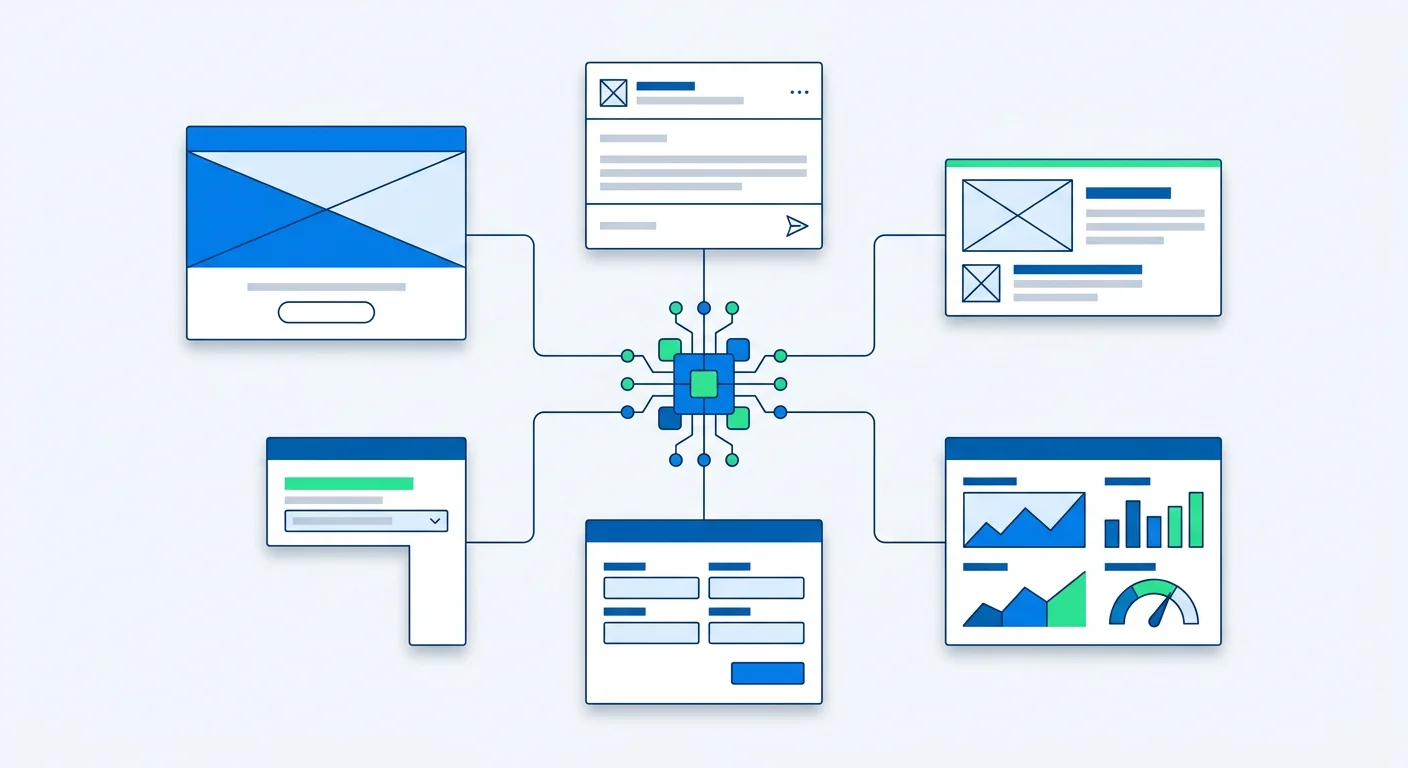
By utilizing a unified platform powered by coordinated agents, you eliminate the need to stitch these disparate tools together. AI Automation becomes seamless because the same exact system that built the landing page is also managing the routing logic, storing the leads, and triggering the email sequences. It is time to replace your fragmented marketing stack entirely. You replace multiple expensive, disjointed point solutions with one comprehensive engine.
The Future is Launching, Not Generating
We are moving past the era of marketing AI as a simple "drafting assistant." The competitive edge in digital marketing no longer goes to the team that can write prompts slightly faster or generate more raw blog posts. It belongs to the team that can collapse the distance between a strategic idea and a live, converting campaign. By embracing coordinated, agentic systems, you stop acting as human middleware and start operating as a true revenue architect.
Ready to stop prompting and start launching?
Replace your fragmented tool stack, eliminate manual handoffs, and let Superpage's coordinated AI specialists build your next high-converting campaign in minutes.
Get Started