

For marketing teams and revenue-focused operators, launching a new initiative often feels less like strategic execution and more like an endless exercise in software logistics. Between writing copy, designing landing pages, configuring email sequences, and setting up ad creatives, getting a single idea out the door routinely takes weeks.
The traditional response to this bottleneck is to adopt more tools. But adding software to a fragmented stack only deepens the integration debt. To truly scale output, teams need to rethink how work gets done. By leveraging automated marketing campaigns powered by AI marketing agents, operators can move from a raw idea to a live, multi-channel funnel in minutes, not months.
Rather than relying on rigid, rule-based triggers or basic prompt generation, modern AI marketing agents work as a coordinated team to handle research, pages, emails, ads, and follow-up natively inside one platform. In a landscape where speed-to-market dictates competitive advantage, eliminating the friction of manual asset assembly is the most direct path to revenue growth.
Key Takeaways
- Traditional automated marketing relies on brittle "if-this-then-that" rules stitched across fragmented point solutions.
- Modern automated marketing campaigns use coordinated AI agents to act as strategists, copywriters, and developers within a single environment.
- By sharing context natively, AI agents ensure messaging remains consistent across landing pages, forms, emails, and ads.
- Consolidating your stack eliminates launch delays, allowing small teams to produce agency-level output without the overhead.
- The human operator's role shifts from manual task execution to high-level strategic governance and campaign review.
The Hidden Costs of Fragmented Marketing Stacks
Most marketing teams operate in a highly fragmented ecosystem. You might use one tool to build a landing page, another to route form submissions, a third to send nurture emails, and native platforms for digital advertising. This fragmentation creates three severe operational bottlenecks:
- Slow launch cycles: Every standalone tool requires manual setup, formatting, and QA. Moving copy from a shared document into a landing page builder, and then formatting emails to match, turns simple campaigns into multi-week administrative projects. Even minor tweaks require repeating the cycle across all platforms.
- Inconsistent execution: Moving text and concepts between disparate systems often dilutes the core message. An ad might promise one outcome, while the landing page it points to focuses on another. Context is frequently lost during these handoffs, severely reducing conversion rates.
- High coordination overhead: Even if you rely on integration platforms to sync data, maintaining the connections between fragmented software becomes a full-time job. The "Zapier tax" is real—when one API updates or a field name changes, the entire campaign can break silently, resulting in lost leads and wasted ad spend.
Ultimately, the cognitive load of managing the stack overtakes the strategic goal of the campaign itself. Marketing managers find themselves acting as amateur system integrators rather than revenue drivers.
Rule-Based Workflows vs. AI Marketing Agents
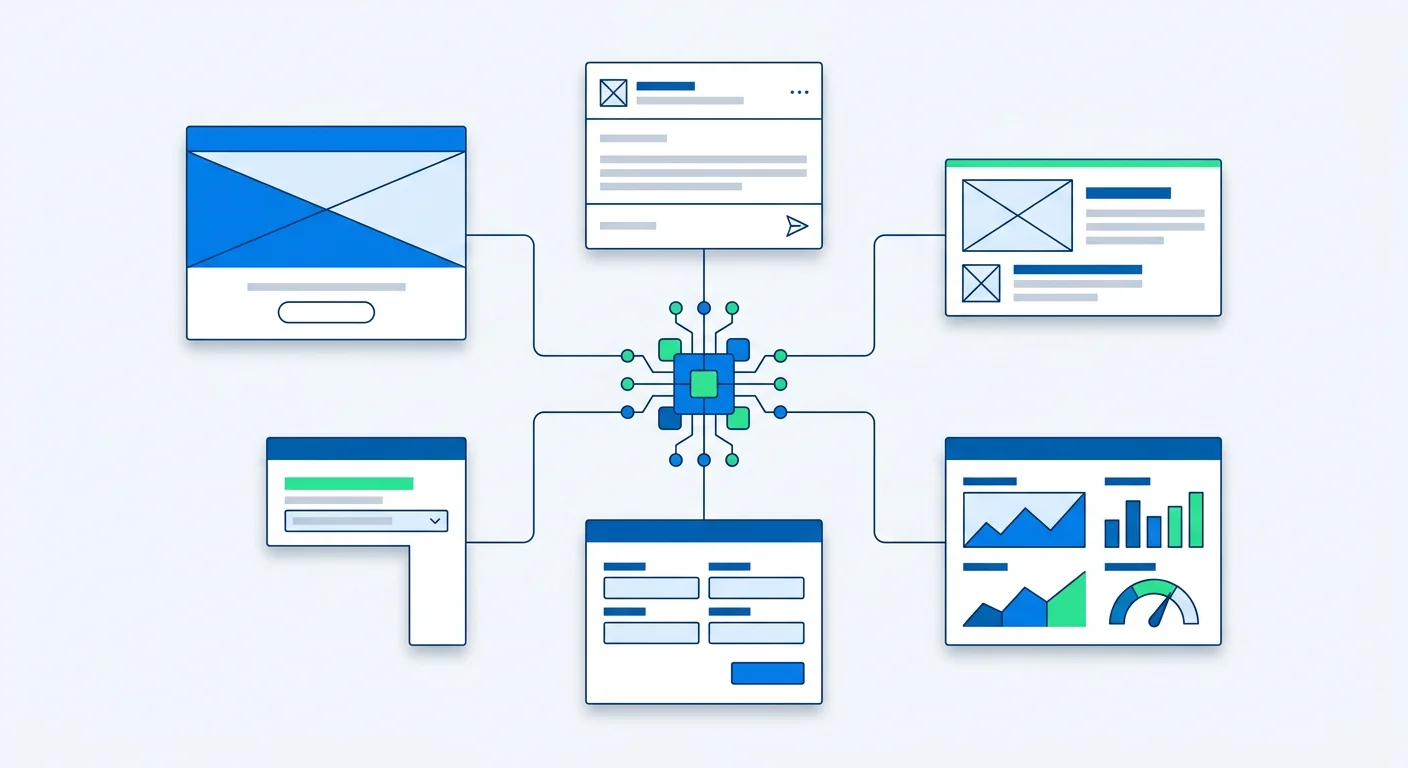
To understand why modern automated marketing campaigns are so revolutionary, it is critical to distinguish between legacy rule-based automation and true AI-driven execution. For over a decade, "marketing automation" merely meant digital routing. It did not create anything; it only moved pre-existing things around. AI agents fundamentally change this dynamic by actively generating the strategy, copy, and layout.
| Capability | Legacy Rule-Based Automation | Modern AI Marketing Agents |
|---|---|---|
| Content Creation | Fully manual. Humans must research, write, and design every asset before loading it into the tool. | Autonomous. Agents research the market, write copy, and generate designs instantly from a single brief. |
| Context Sharing | Non-existent. The email tool has no idea what the landing page says unless you manually check for alignment. | Unified. The agent building the ad copy natively understands the messaging used on the landing page. |
| Logic Definition | Rigid "If/Then" trees. Users must predict every possible branch and map logic manually. | Intent-driven. Agents configure adaptive forms and qualification sequences based on campaign goals. |
| Launch Timeline | Weeks to months. Requires coordinating copywriters, designers, and operations managers. | Minutes to hours. A single operator can oversee and deploy an entire multi-channel campaign instantly. |
What Are Automated Marketing Campaigns in the AI Era?
Historically, "marketing automation" simply meant workflow routing. It meant setting up logic chains that said, "If a user submits this form, send them this pre-written email." The execution of the campaign assets themselves—the writing, the designing, the publishing—was entirely manual.
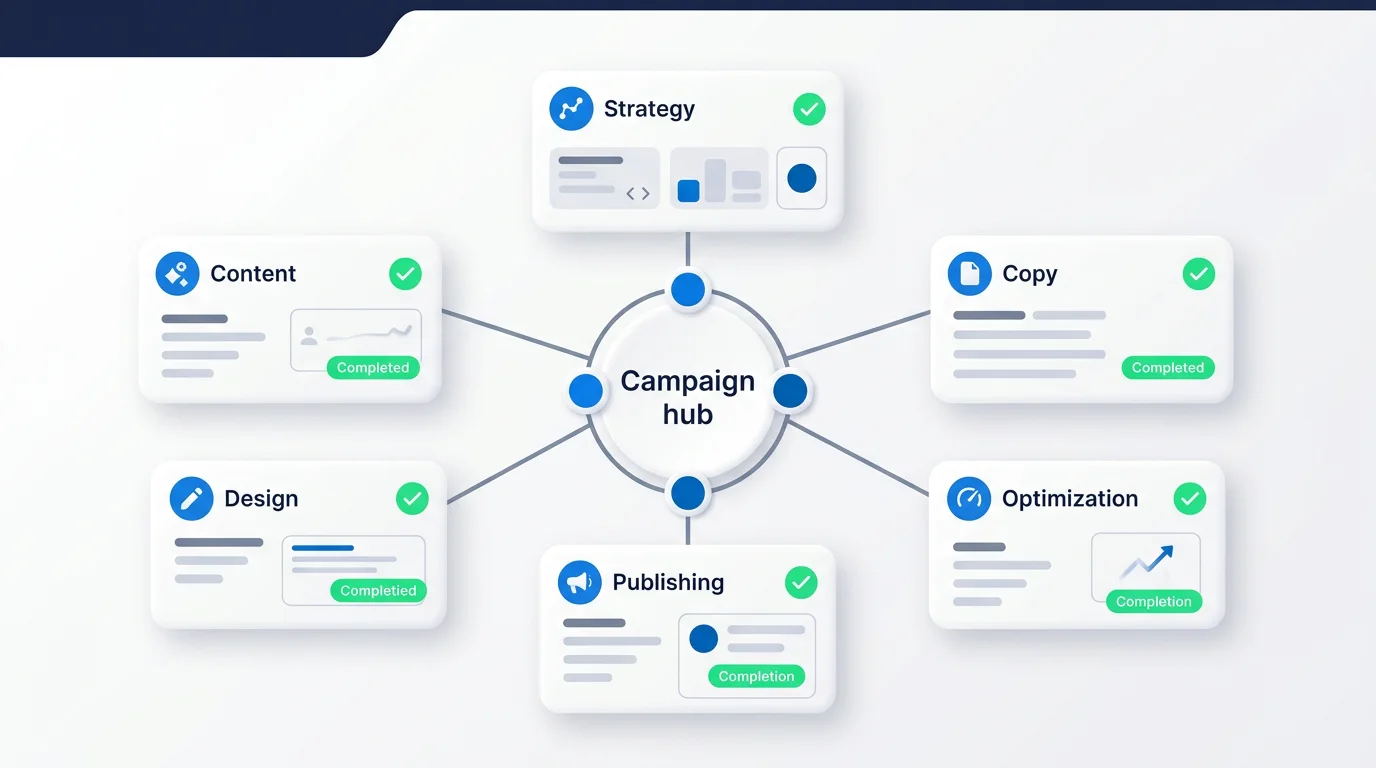
Today, automated marketing campaigns involve autonomous, specialized AI agents generating and connecting the assets inside a single platform. Instead of a single chatbot asking for repetitive prompts, Superpage utilizes distinct AI specialists for different marketing functions. They share a unified context window, meaning the agent building your ad knows exactly what the agent building your landing page created.
1. Coordinated Strategy and Positioning
Before a single word of copy is written or a pixel is placed, automated campaigns require a foundation. An AI strategy agent analyzes your market, your existing brand tone, and the specific goal of your initiative. Leveraging AI strategy and positioning ensures that your core value proposition is sharply defined. The system establishes the "North Star" for the campaign, which is then fed automatically to every other agent in the workflow. This eliminates the drift that typically happens when a brief is passed from a strategist to a freelance copywriter.
2. Building Pages and Funnels
Instead of staring at a blank canvas in a drag-and-drop editor, an AI agent instantly generates complete, conversion-optimized layouts. Functioning as an advanced AI funnel builder, the platform handles copywriting, design spacing, mobile responsiveness, and structural hierarchy simultaneously. You get a fully functional page tailored to your specific campaign without waiting on a dedicated developer or designer to finish their sprint. The result is a high-converting asset ready for traffic on day one.
3. Intelligent Forms and Qualification
Capturing intent is the pivot point of any automated marketing campaign. Rather than embedding a generic third-party form, campaigns benefit from native Forms & Qualification routing. AI agents configure the exact fields needed based on the campaign's context, instantly routing qualified leads to high-priority sales calendars while filtering out unqualified traffic. This native qualification ensures your sales team only spends time on revenue-generating conversations.
4. Writing and Scheduling Nurture Emails
A campaign fails if the follow-up falls flat. Once a lead opts in, AI agents immediately deploy context-aware email sequences. Because the email agent has direct access to the landing page strategy, the messaging logically continues the conversation rather than reverting to a generic newsletter tone. You can deploy robust AI automation workflows that nurture leads over days or weeks, handling objections and pushing them toward conversion without ever logging into a separate email service provider.
5. Launching Ads That Convert
Creating ad variations is one of the most mechanically tedious parts of campaign execution. AI agents natively generate ad copy, suggest creative angles, and structure campaigns for seamless deployment. By aligning the ad copy directly with the downstream funnel—and integrating with frameworks for Meta ad automation—your message match remains perfect. This lowers bounce rates, increases ad relevance scores, and reduces your Cost Per Acquisition (CPA) right out of the gate.
"Automation shouldn't mean generic execution. The goal of AI marketing agents is to combine the unyielding speed of software with the strategic consistency of a world-class marketing team."
The Step-by-Step Automated Campaign Workflow
Transitioning to autonomous execution doesn't mean giving up control; it means shifting how you interact with your tools. When deploying an automated marketing campaign, the modern workflow moves progressively from high-level direction to detailed execution:
- Strategic Ingestion: The operator inputs a core business goal, target audience, and central offer. The AI strategy agent processes this brief, reviews existing brand guidelines, and proposes a multi-channel angle.
- Asset Blueprinting: Once the strategy is approved, the system blueprints the campaign architecture—determining the necessary landing pages, form structures, and post-opt-in email sequences required to achieve the goal.
- Simultaneous Generation: Specialized agents execute concurrently. The copy agent writes the ad variations and emails, while the design agent builds the page layout and wires the forms. Because they share a context engine, the tone remains unified.
- Logic and Routing Configuration: The platform autonomously links the assets, ensuring data flows perfectly from ad click to lead capture to calendar booking or checkout, eliminating manual API mapping.
- Human Governance and Launch: The operator conducts a final review, editing copy or adjusting designs visually. With a single click, the fully integrated campaign is pushed live to the market.
Practical Examples of Autonomous Campaigns
How does this translate to actual business outcomes? When you eliminate the mechanical friction of campaign building, you unlock the ability to test new markets, verticals, and offers at unprecedented speeds. Below are practical examples of automated marketing campaigns in action.
B2B SaaS Lead Generation
A SaaS company wants to penetrate a niche vertical, such as healthcare logistics. Traditionally, this requires a massive operational lift. Leveraging AI marketing automation for SaaS, the team generates a hyper-targeted landing page addressing healthcare compliance, a custom lead magnet delivery sequence, and industry-specific ad copy. The entire funnel is generated, linked, and deployed in an afternoon, allowing the growth team to test the vertical's viability without tying up the engineering department.
D2C eCommerce Product Launches
An eCommerce brand needs to test multiple angles for a new product bundle before the holiday rush. The automated campaign platform generates distinct, high-converting checkout pages for each angle, wires up post-purchase upsell emails, and simultaneously crafts variations for social media. Because the system natively understands ad structures, deploying Meta ad automation directly linked to the newly generated pages ensures a frictionless buying experience that maximizes Return on Ad Spend (ROAS).
Consultants and Coaches
A B2B consultant launching a new advisory cohort needs a complete webinar registration funnel. The AI platform generates the registration landing page, sets up the multi-day email reminder sequence to maximize attendance, and pre-writes the post-webinar urgency sales emails. By automating the mechanical setup, the consultant is freed to focus entirely on their presentation and delivering value to attendees.
The Crucial Role of Human Review
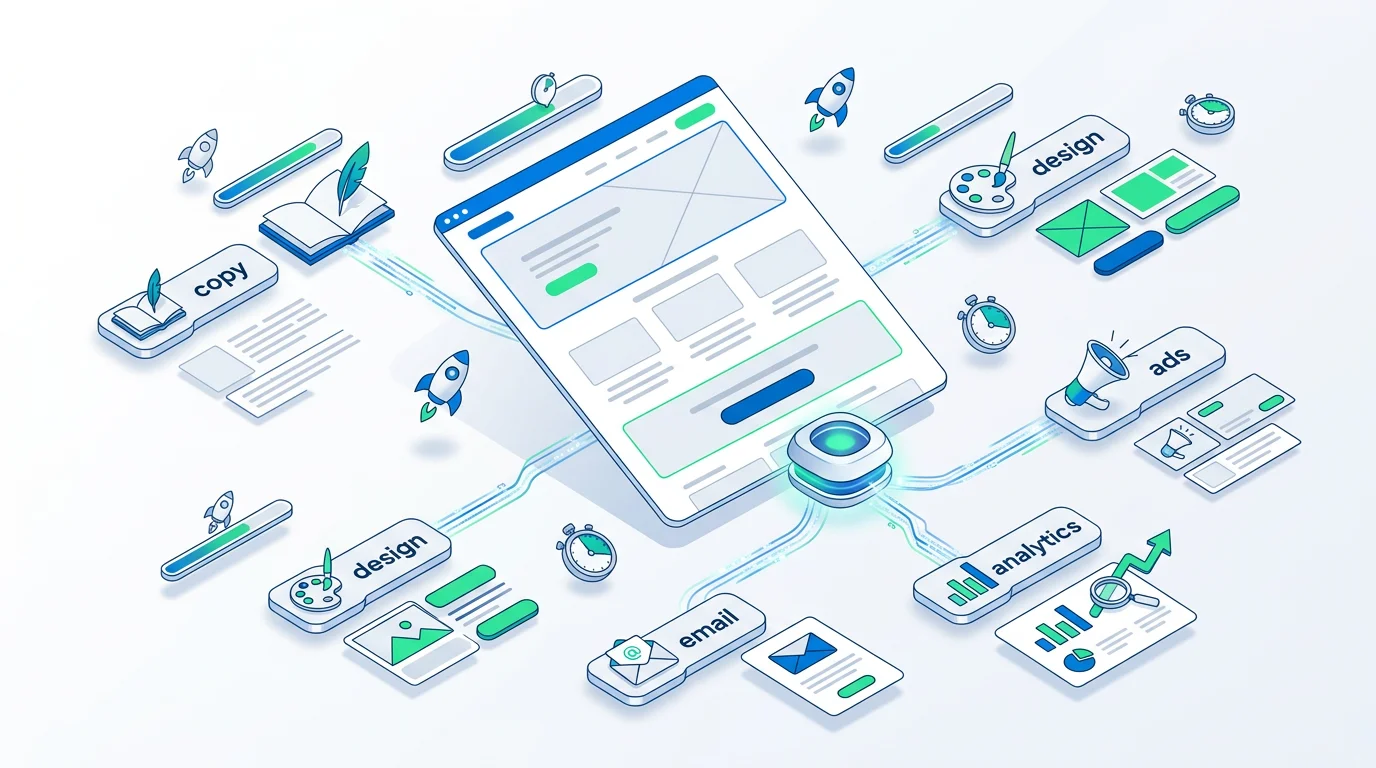
It is important to clarify that automated marketing campaigns do not eliminate the need for marketers. Instead, they elevate the marketer's role. While AI agents handle the heavy lifting of writing, designing, coding, and connecting assets, the marketing operator remains the strategic director. The focus shifts entirely from doing the busywork to guiding the outcome.
Campaign governance is built into the core of the automated workflow. Agents are strictly bound by the brand guidelines, tone parameters, and strategic goals set during the initial brief. They do not publish rogue content; they stage fully constructed campaigns for final human approval.
Human review becomes about tweaking tone, adjusting the core offer, and ensuring the campaign aligns perfectly with broader company objectives. Because the foundational assembly work is completed in minutes, teams finally have the luxury of spending their time on high-leverage optimization—testing new offers, interviewing customers, and refining strategy—rather than mechanical assembly.
Frequently Asked Questions
How do automated marketing campaigns differ from standard email automation?
Standard email automation only handles message delivery based on rigid "if/then" rules. Automated marketing campaigns powered by AI actively create the assets—generating the landing page, writing the ad, configuring the form, and drafting the emails—while managing the holistic strategy across all channels simultaneously.
Will this completely replace my existing tech stack?
For many teams, yes. A unified AI platform can replace standalone landing page builders, email marketing tools, and form software. By consolidating these point solutions into a single environment, you eliminate data silos and integration costs.
How does the AI maintain our unique brand voice?
Before execution begins, the AI strategy agent analyzes your website and existing materials to establish a brand profile. This context is shared across all specialized agents (copywriters, designers), ensuring that every piece of content sounds like it came from your best internal team member.
Do I need technical skills to deploy these campaigns?
No. The platform eliminates the need to map APIs, write custom code, or format complex designs. If you understand your business goals and can review copy, you have all the skills necessary to launch comprehensive funnels.
Are these automated campaigns suited for B2B or B2C?
Both. Because the AI adapts to the strategic brief, it can generate long-form, multi-week educational nurture sequences for complex B2B sales cycles, just as easily as it can generate high-urgency, direct-response checkout funnels for B2C eCommerce brands.
Ready to automate your marketing campaigns?
Stop stitching together disjointed tools. Replace your fragmented marketing stack with Superpage and launch complete, coordinated campaigns in minutes.
Get Started with Superpage