

If you are running Facebook or Instagram campaigns today, Meta ad automation is no longer a competitive advantage—it is the baseline. Meta’s Advantage+ algorithms have largely solved the problem of finding the right audience and testing dynamic creative at scale. But here is the reality most growth operators and marketing teams ignore: getting a cheaper click means absolutely nothing if your post-click experience drops the ball.
The true bottleneck for modern marketing teams is not ad optimization. It is the deep fragmentation between the ad itself and the rest of the conversion funnel. When your Meta ads are managed in Ads Manager, your landing pages are built in a separate CMS, your forms live in another widget, and your email follow-ups are chained together via third-party webhooks, you lose speed, consistency, and ultimately, revenue.
Key Takeaways
- Meta's native automation (Advantage+) handles distribution, but ignores the post-click journey.
- Fragmented marketing stacks cause "message disconnect," leading to high bounce rates and wasted ad spend.
- Relying on single-prompt AI chatbots to write copy still requires manual assembly across multiple platforms.
- Coordinated AI marketing agents replace the entire stack, generating and launching ads, pages, forms, and follow-ups concurrently.
The Illusion of "Automated" Meta Ads
Most "automated" workflows treat advertisements as isolated assets. A marketer might use a generative AI chatbot to brainstorm ad copy, generate an image mid-journey, paste it all into Ads Manager, and let Meta's machine learning handle the delivery. This is only partial automation. It optimizes the impression but ignores the conversion.
When automation stops at the ad platform level, teams run into a predictable set of failure points:
- Message Disconnect: If an automated ad promises a specific offer or speaks to a niche pain point, but the user clicks through and lands on a generic homepage, bounce rates skyrocket. Meta interprets this rapid bounce as a low-quality ad experience and penalizes your campaign with higher CPMs (Cost Per Mille).
- Sluggish Deployment: Launching a new testing angle requires coordinating a media buyer, a copywriter, a web designer, and marketing ops. By the time the landing page and email sequence are ready, the market opportunity may have passed.
- Data Silos: Meta knows who clicked and who triggered a standard event pixel. But it lacks deep context on lead qualification, firmographics, or sales pipeline stages—data that lives entirely in your CRM or form software.
Advantage+ Context: What Meta Actually Automates
To understand the gap in modern digital advertising, you first must understand what Meta’s Advantage+ system was designed to solve. When privacy updates reduced visibility into off-platform conversions, Meta pivoted away from granular, manual audience targeting and heavily invested in machine learning models that could predict user behavior with fewer data points.
Advantage+ Shopping Campaigns (ASC) and App Campaigns effectively automated the distribution side of the advertising equation. Instead of building dozens of ad sets targeting specific lookalike audiences or interests, marketers now feed Meta a large budget, a broad geographic area, and a massive pool of creative assets. Meta’s algorithm then autonomously tests combinations of text, headlines, and video, finding the cheapest possible impression and click in real-time.
This is an incredible engineering feat, but it created a false sense of security for marketing teams. Marketers began confusing "automated distribution" with "automated marketing." Advantage+ is exceptionally good at finding a user who is likely to click an ad, but it has zero control over what happens after that click occurs. It cannot build the page, it cannot qualify the lead, and it cannot follow up. It is an engine that drives traffic to a bridge, but it is entirely up to you to ensure that bridge is built.
The Core Automation Limits: Where Meta Falls Short
The limitations of Meta’s native tools become glaringly obvious the moment you step outside the Ads Manager dashboard. The first major limit is the inability to adapt to multi-stage qualification. Meta’s lead generation forms (Instant Forms) are notorious for producing high volumes of low-intent leads because they autofill user data. While this decreases the Cost Per Lead (CPL), it overwhelms sales teams with junk data, destroying the actual Return on Ad Spend (ROAS).
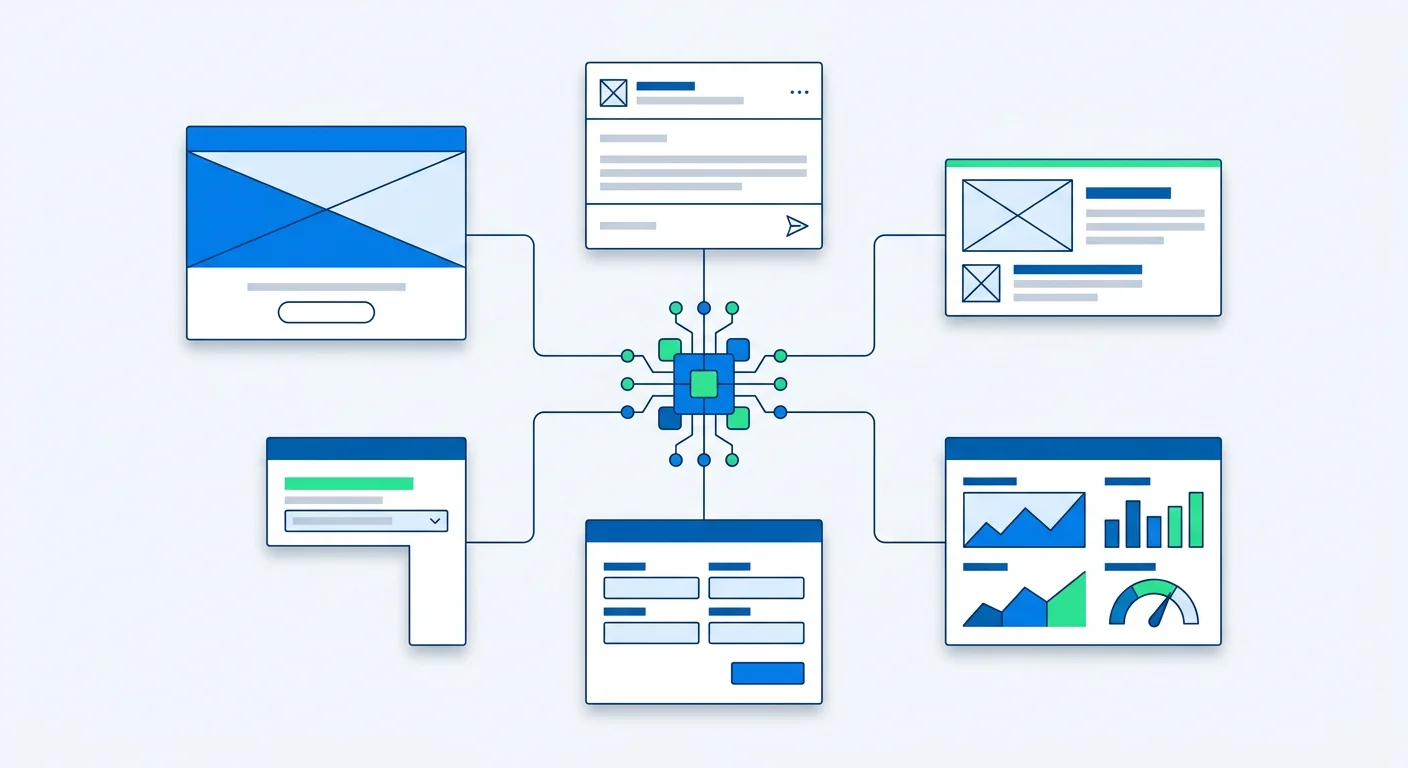
When teams attempt to move off-platform to solve this, they run into the second limit: architectural fragmentation. Meta cannot natively read your CRM data to dynamically adjust your ad creative based on pipeline velocity. It cannot spin up a unique follow-up sequence based on the exact combination of ad copy the user saw. If you want to build high-converting AI lead generation systems, you are forced to rely on complex Zapier routes, custom APIs, and manual data mapping across three or four different software providers.
Finally, there is the limit of creative context. Meta can mix and match the headlines and images you upload, but it cannot ideate new, strategically cohesive angles that tie into your broader brand narrative. It relies entirely on the raw materials you provide. If your input is generic, the output is generic—no matter how advanced the distribution algorithm is.
| Campaign Feature | Meta Native (Advantage+) | Full-Funnel AI Agents |
|---|---|---|
| Ad Copy & Creative | Mixes uploaded assets dynamically | Generates distinct psychological angles natively |
| Audience Targeting | Fully automated via Machine Learning | Aligns with Meta ML via direct message-market fit |
| Landing Page Creation | N/A (Requires external CMS) | Generated instantly to match ad narrative |
| Lead Qualification | Basic autofill forms (High junk volume) | Dynamic, multi-step routing forms built-in |
| Post-Conversion Nurture | N/A (Requires external ESP/CRM) | Automated email/SMS sequences deployed concurrently |
Why Prompting Chatbots is Not Campaign Automation
Since the generative AI boom, teams have tried to speed up their Meta ad creation by chaining prompts together. "Write me 5 Facebook ad hooks for my B2B SaaS." "Now turn hook #1 into a landing page headline." "Now write a 3-part email sequence for the leads."
While this generates text faster, it does nothing to solve the assembly problem. You still have to manually copy the ad text into Meta, build the page in your CMS, format the forms, map the form fields to your email provider, and build the automation logic in another tool. You are still playing middleman between six different software platforms.
"True campaign automation doesn't mean writing ads faster. It means deploying a seamless narrative from the first impression to the final follow-up email without ever leaving your platform."
The Shift to Coordinated AI Marketing Agents
To fix the broken funnel, marketing teams must move away from single-point prompt generation and adopt system-wide execution. This is exactly why Superpage was built. We believe in marketing built by agents—not prompts.
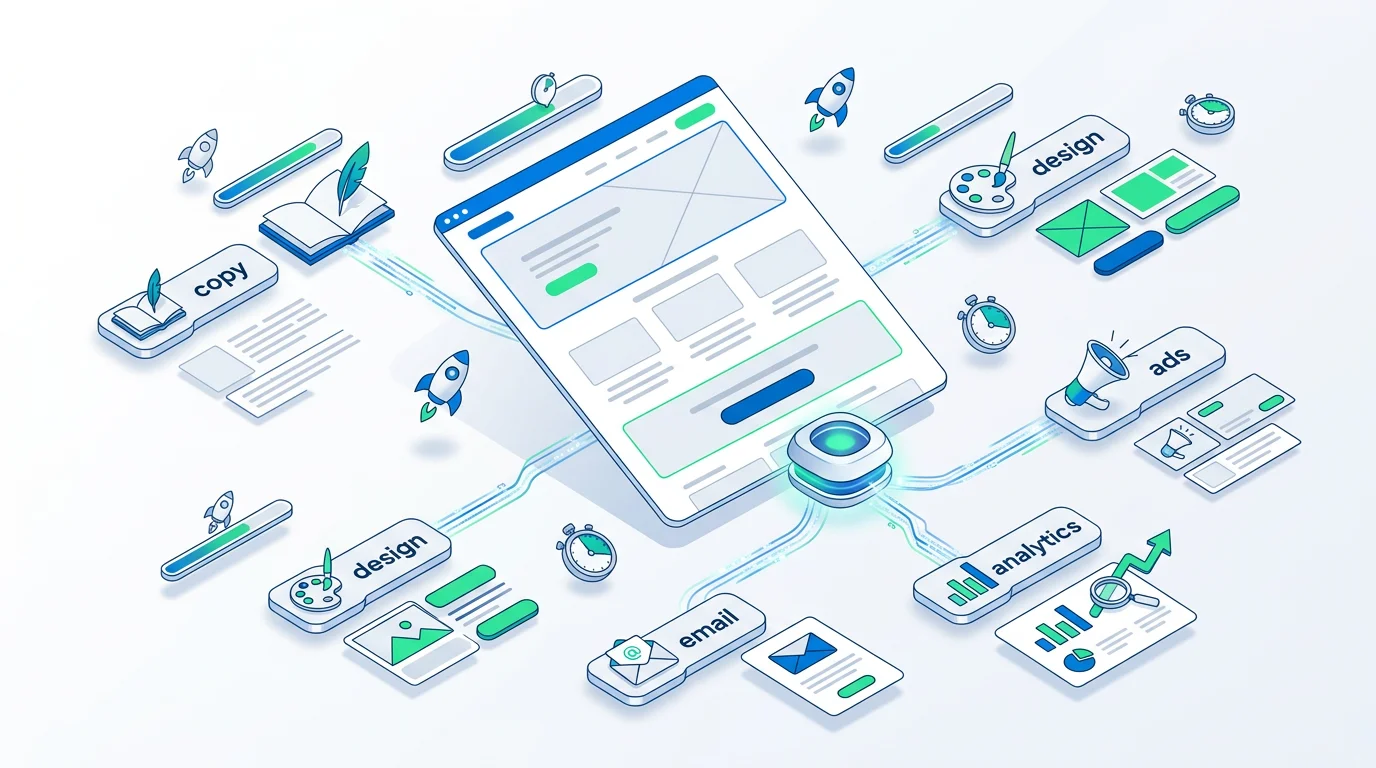
Instead of acting like a single chatbot that needs constant manual direction, coordinated AI specialists plan and generate the connected assets of a campaign simultaneously. When an agent creates a new Meta ad angle, a companion agent automatically updates the landing page to match the precise hook, while another prepares the exact qualification logic and follow-up emails.
1. Launching Complete Campaigns in Minutes
Speed to market is a massive competitive advantage, especially for early-stage SaaS companies and agile D2C brands. You cannot afford four-week launch cycles to test a single funnel. By replacing your fragmented marketing stack with one cohesive platform, AI agents can take a raw positioning idea and output the entire conversion path in minutes. Your ad strategy, creative generation, page build, and form setup happen concurrently.
2. Ensuring Absolute Message-Match Consistency
Ad-to-page relevance directly dictates your cost per acquisition. If a user clicks an ad highlighting "AI-powered scheduling," the landing page headline must immediately reinforce "AI-powered scheduling." Coordinated AI marketing ensures that the primary hook, value proposition, and tone of voice seamlessly transition from the Facebook feed right down to the qualification forms. There is no manual mapping required to maintain narrative continuity.
The Message-Match Workflow: Connecting the Click to the Conversion
If we accept that ad-to-page relevance dictates cost per acquisition, then executing a perfect message-match workflow becomes the most critical operation in your marketing team. In a traditional setup, achieving this requires immense manual oversight. A copywriter drafts five different ad angles. A media buyer traffics them into Meta. A web designer duplicates a landing page five times. A marketing operations specialist ensures the headlines align and maps the form tracking parameters. This process is slow, prone to human error, and heavily discourages rapid experimentation.
When you utilize an AI landing page builder coordinated with your advertising agents, the message-match workflow becomes instantaneous. The AI understands the exact psychological hook it used in Ad Variant A (e.g., "Reduce software bloat") and automatically hardcodes that exact verbiage into the headline, subheadline, and primary benefits of Landing Page A.
Furthermore, this continuity extends to the follow-up. By deeply integrating these systems, you are building truly automated marketing campaigns where the welcome email directly references the core pain point the user clicked on in their Facebook feed three minutes prior. This level of hyper-personalized narrative continuity drastically reduces bounce rates, increases form completions, and elevates your overall conversion rate.
3. Closing the Loop with Automated Lead Nurturing
Generating the click and capturing the lead is only half the battle. High-performing Meta ad automation extends past the conversion event. When the entire stack is unified, the platform can automatically route leads based on their specific form responses, instantly trigger customized email and SMS sequences, and alert your sales team at the exact moment a high-intent prospect qualifies themselves.
How to Structure a Fully Automated Meta Ads Funnel
If you want to move beyond basic Advantage+ targeting and build a resilient, high-converting system, here is how a coordinated agent architecture executes a campaign:
- The Strategy Ingestion: You provide the AI with your core value proposition, target audience, and primary campaign goal (e.g., booked demos for a SaaS product).
- The Multi-Variant Ad Creation: The AI generates distinct psychological angles for the Meta ads. Instead of just changing the image, it creates entirely different narrative hooks—one focusing on time saved, another on revenue gained, and a third on competitive risk.
- The Dynamic Page Generation: For every unique ad angle created, a corresponding landing page is built. The headline, subcopy, and benefits on the page adapt to mirror the ad that drove the click.
- The Frictionless Capture: The platform deploys optimized qualification forms tailored to the specific offer. It captures the data without sending the user to an external Typeform or Calendly link.
- The Behavioral Follow-Up: Based on how the user interacted with the form, immediate follow-up sequences are deployed. High-value leads get VIP calendar links; unqualified leads are routed to a self-serve webinar.
Real-World Examples: Automated Meta Ads in Action
To illustrate how this coordinated architecture functions in practice, let us examine two distinct use cases where fragmented toolstacks typically cause campaigns to fail. In both scenarios, relying on a unified platform driven by AI marketing agents enables rapid deployment and superior unit economics.
Example 1: The B2B SaaS Demo Funnel
An early-stage SaaS company needs to generate qualified booked demos for its new financial reporting tool. Instead of manually building out assets, the team inputs their core positioning into the platform. The AI generates three ad angles: one focused on saving the CFO time, one focused on eliminating spreadsheet errors, and one focused on real-time board reporting. Concurrently, it generates three distinct landing pages matching these angles. When a CFO clicks the "spreadsheet errors" ad, they are taken to a page that specifically highlights error reduction. The integrated form qualifies the company size, and if they meet the threshold, instantly routes them to a calendar scheduling tool, completely bypassing the manual SDR outreach phase.
Example 2: The High-Ticket Consultant Webinar
A management consultant wants to run Meta ads to a new automated webinar funnel. The native Meta automation handles finding the audience, but the post-click experience is traditionally heavily disjointed. By utilizing a full-funnel AI agent, the consultant launches the entire campaign in minutes. The ad copy seamlessly connects to the webinar registration page. As soon as the user registers, the platform triggers a highly personalized 5-part email sequence designed to maximize webinar attendance, utilizing the exact phrasing and promises made in the initial Meta ad.
Frequently Asked Questions About Meta Ad Automation
Does full-funnel automation replace my media buyer?
Not necessarily, but it fundamentally shifts their role. Instead of spending hours matching ad copy to landing pages and manually duplicating campaigns, your media buyer becomes a strategic director. They feed the AI high-level positioning, set budget constraints, and analyze the resulting business metrics, allowing them to manage significantly more ad spend with less operational friction.
How does this differ from using ChatGPT and Zapier?
ChatGPT is a stateless prompt generator. It does not natively build pages, route forms, or deploy emails. Zapier connects tools, but it relies on you to build and maintain the logic. A coordinated AI platform is entirely unified—there are no APIs to break, no webhooks to map, and the agents possess deep context on your campaign from the first ad impression down to the final follow-up email.
Will Meta penalize me for rapid page generation?
No. Meta penalizes poor user experiences, slow loading speeds, and misleading ad-to-page consistency. Because our AI marketing agents generate highly relevant pages that perfectly match the ad copy, the bounce rates plummet, and session times increase. Meta’s algorithm interprets this as a high-quality signal, often rewarding the campaign with lower CPMs.
Can I still manually edit the assets the AI creates?
Absolutely. The goal of campaign automation is to accelerate your workflow by getting you to the 95% completion mark in minutes. You maintain full editorial control to tweak headlines, adjust form fields, or refine the email copy before pushing the campaign live.
Stop Stitching Together Tools
The future of Meta ad automation is not about writing better prompts into ChatGPT and copying the results into Ads Manager. It is about moving from an abstract idea to a live, converting funnel without handoffs, manual prompt chains, or tool fragmentation.
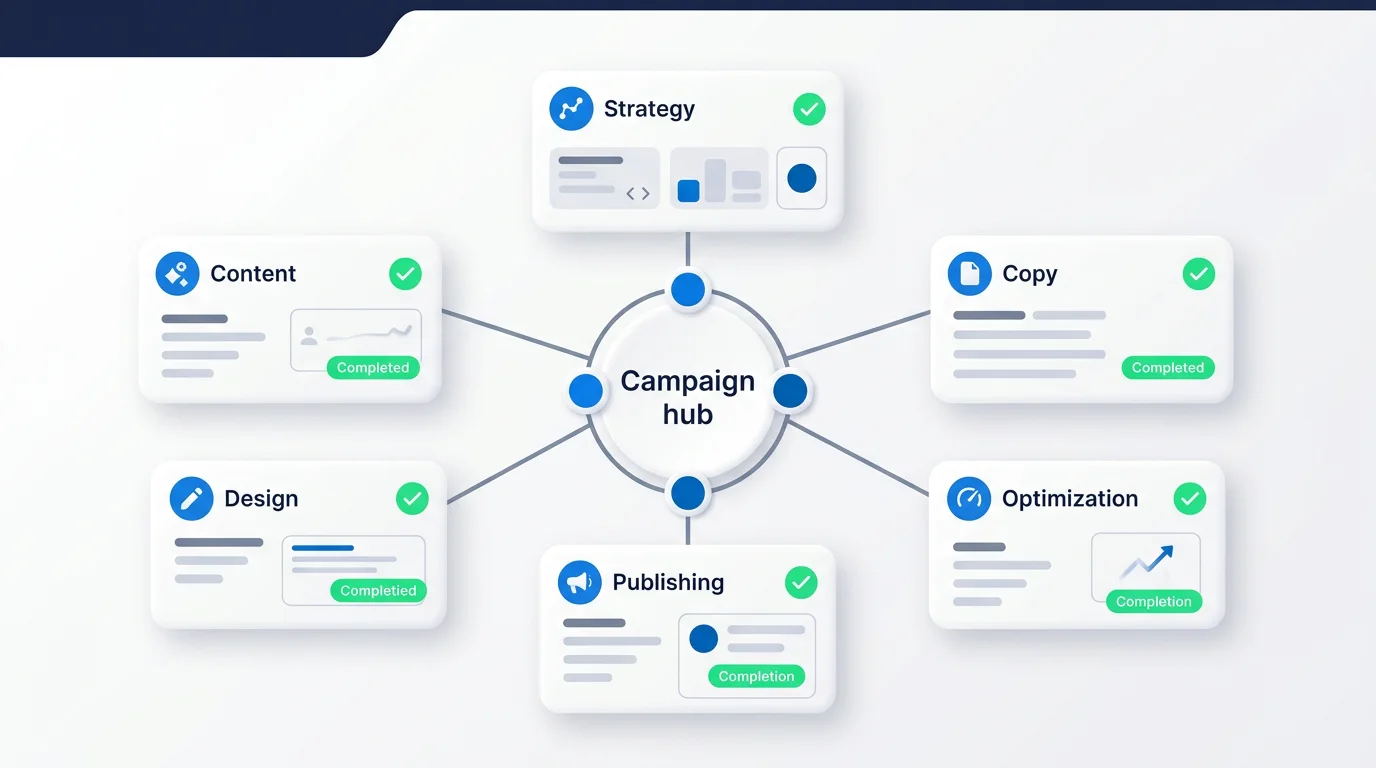
By leveraging a platform that coordinates AI specialists, your team can finally scale its operational output. You can replace your entire marketing stack with one system, ensuring that every ad, page, form, and email works in perfect harmony. It is time to stop playing middleman to your software and start focusing on strategy, speed, and revenue.