

An AI marketing platform connects the work of researching, building, publishing, and optimizing marketing campaigns. Instead of stopping at an ad headline or a landing-page draft, it helps move a campaign from an initial opportunity to live execution, conversion analysis, and lead follow-up.
The name can be confusing, though. An AI writing tool, a general AI model, a workflow builder, and an enterprise customer-engagement suite can all sound like an “AI platform for marketing.” The useful question is not how many AI features a product has. It is which parts of your campaign workflow it connects—and what evidence informs the next decision.
What is an AI marketing platform?
For campaign work, an AI marketing platform is software that uses AI to help turn marketing research into campaign assets, publish through supported channels, and improve the conversion path using performance and behavioral evidence.
“Platform” should describe connected work. A generated ad needs a destination page. That page needs a conversion action. A captured lead needs a next step. Measurement needs to inform what the team changes afterward. The value lies in those connections, not simply in generating more content.
That does not mean every platform covers every channel or every action. A useful definition leaves room for different scopes while making those scopes clear.
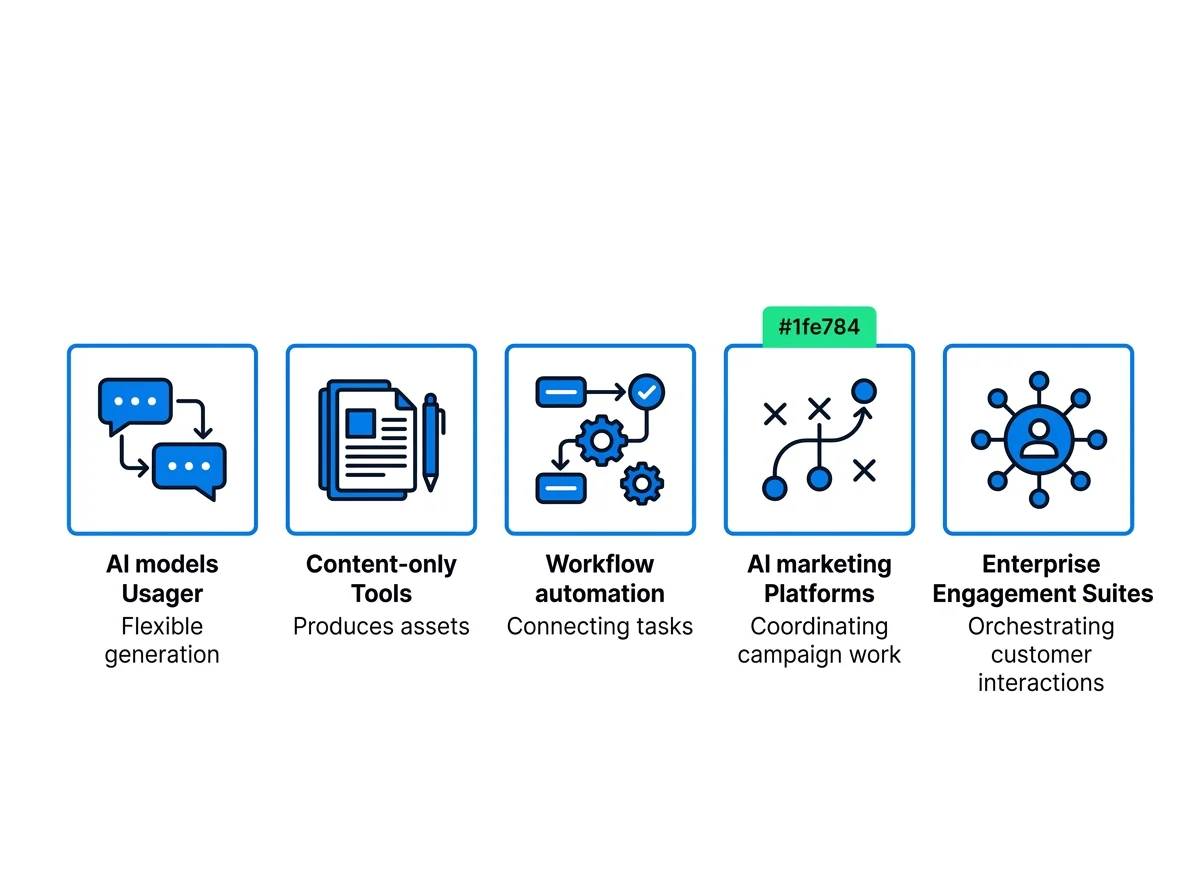
How the category differs from adjacent tools
| Approach | Primary job | Fit boundary |
|---|---|---|
| General AI model | Help with reasoning, drafting, and analysis across many tasks. | A conversation alone is not a campaign publishing and measurement workflow. |
| Content-only AI tool | Produce or refine copy and creative inputs. | Execution, conversion analysis, and follow-up remain separate tasks. |
| Workflow automation | Run predefined triggers, conditions, and actions across systems. | Moving data does not itself provide campaign research or evidence-led CRO. |
| Enterprise engagement suite | Coordinate customer data, channels, and lifecycle journeys. | Broad lifecycle needs can bring substantial implementation and operational demands. |
| Campaign-focused AI marketing platform | Connect research, campaign execution, conversion analysis, and follow-up. | Fit depends on supported channels, connected data, and campaign needs. |
These categories can overlap. Marketing automation runs a sequence after a trigger; AI can help develop campaign inputs or interpret conversion evidence. An AI marketing automation platform may combine both. What matters is whether that combination addresses the work your team actually needs to do.
The practical campaign loop: six connected steps
Imagine a team launching a campaign to book consultations. The goal is not merely to generate ads. It is to connect relevant demand with a clear offer, a usable page, and an appointment-setting path. Here is how to evaluate that workflow, including the evidence and human choices at each stage.
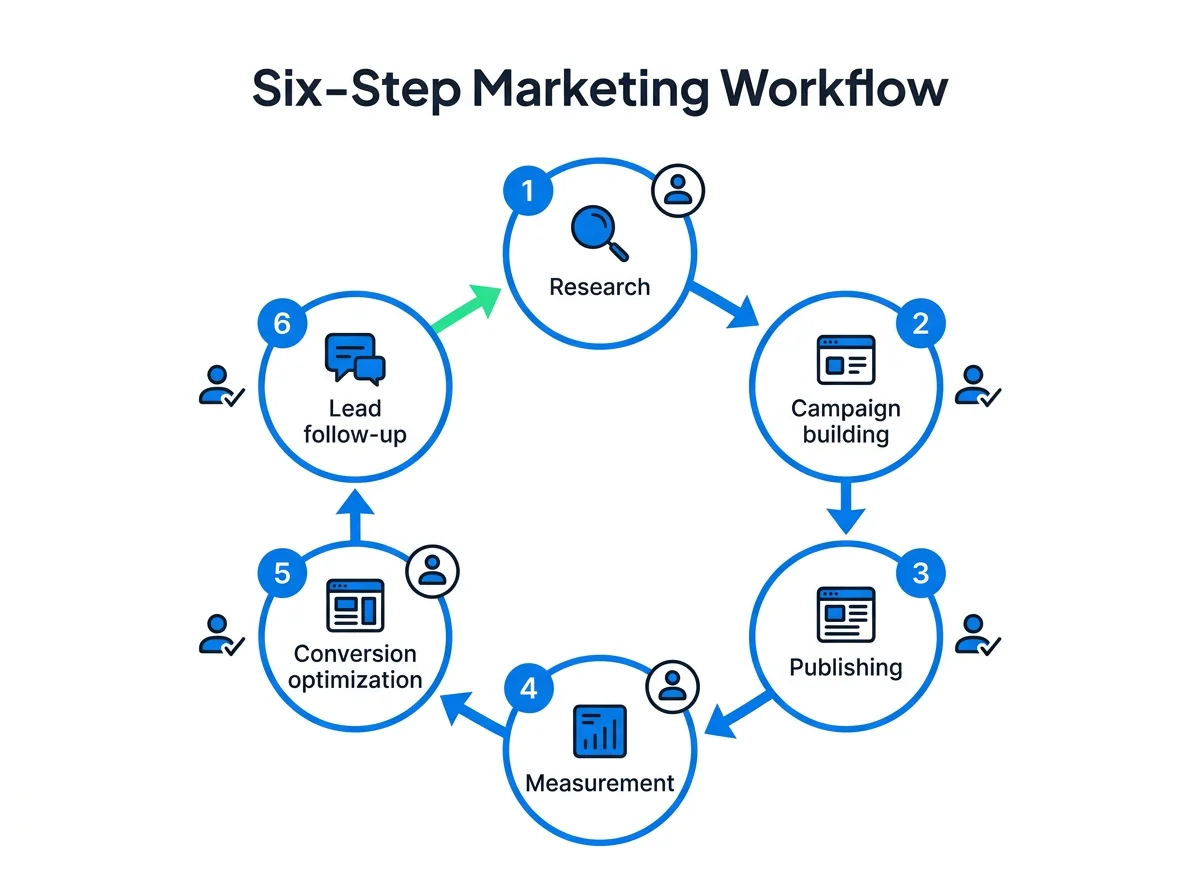
1. Research the campaign opportunity
Start with the campaign question: who is the offer for, what problem does it address, and what demand could you reach? For a search campaign, keyword research helps turn that question into potential search terms and campaign inputs.
Superpage supports Google Ads keyword research, including generated keyword and negative-keyword lists.
- Evidence to use: Keyword research, buyer questions, and the offer’s relevance to the search intent.
- Human choice: Select the audience, offer, and terms worth pursuing. Decide which searches are outside the campaign’s scope.
A research feature should help answer a launch question, not just produce a longer list of keywords.
2. Build the campaign and tracking foundation
Translate the opportunity into usable campaign components: messaging, ads, a landing page, a form, and a clear next step. Build the measurement foundation alongside those assets rather than treating it as a separate cleanup task.
Superpage builds campaign assets and pages and funnels across a connected workflow. It also supports Google Ads CAPI implementation.
- Evidence to use: The launch brief, research findings, brand context, and intended conversion action.
- Human choice: Review the offer, claims, campaign structure, and destination page. Define what counts as a useful conversion.
For a consultation campaign, a form submission and a booked appointment are distinct milestones. Decide which one the campaign is designed to produce and how the next step will work.
3. Publish through the relevant paid channels
Publishing turns campaign inputs into live execution. Superpage supports Google Ads workflows and Meta Ads. For Meta, it generates ad copy and creative, configures campaign structure and targeting, and publishes to a connected Meta account.
- Evidence to use: The approved assets, intended audience, destination page, and measurement setup.
- Human choice: Set the channel strategy and budget, and review the campaign before launch.
Channel support is not the same as identical functionality across channels. Evaluate the specific workflow you plan to run on Google Ads or Meta Ads rather than relying on a broad “cross-channel” label.
4. Measure outcomes and observe visitor behavior
Once the campaign is live, look beyond ad activity. Attribution data helps connect marketing activity with outcomes. Session recordings show how people move through the website, giving the team behavioral context for those outcomes.
- Evidence to use: Actual session recordings, attributed conversions, and progress through the conversion path.
- Human choice: Identify which audience, page, or funnel step deserves attention. Separate observations from assumptions.
For example, visitors leaving around a form is an observation. “The form asks for too much information” is a possible explanation. The distinction matters when choosing what to change.
5. Optimize the conversion path
Conversion-rate optimization, or CRO, addresses what happens after the click. That might mean making the offer clearer, adjusting a form, improving page flow, or making the booking step easier to understand.
Superpage’s AI CRO analyzes actual session recordings and first-touch and last-touch marketing attribution data. It identifies conversion bottlenecks and recommends what to optimize next.
- Evidence to use: Behavioral patterns alongside attributed outcomes.
- Human choice: Select the improvement to prioritize, review the recommendation, and assess what happens after the change.
A useful optimization recommendation connects an observed problem with a specific next action.
6. Follow up with leads and set appointments
Lead capture is not the end of an appointment-led campaign. A prospect still needs a path from interest to a scheduled conversation. Superpage provides AI Voice Agents that call leads as appointment setters.
- Evidence to use: Captured lead information, qualification context, and booking status.
- Human choice: Define which leads should receive appointment-setting calls, the purpose of the call, and when a person should take over.
Then return to the beginning. Compare the leads and appointments the campaign produces with the audience and offer you intended to reach. Use that evidence to revisit the keywords, messaging, page, and follow-up path.
How to evaluate an AI marketing platform
The best AI marketing platform for your team is the one that addresses your actual workflow gaps. Start with one representative campaign and evaluate these criteria:
- Research coverage. Does it help answer the campaign question before launch? For search acquisition, look for usable keyword research rather than content brainstorming alone.
- Build capability. Can research become campaign inputs, assets, and a destination page? Look at how much manual reconstruction remains between steps.
- Publishing scope. Does it support your required channels and actions? Evaluate Google Ads and Meta Ads separately.
- Measurement inputs. What campaign and behavioral evidence informs optimization? Look for a connection between recommendations, session recordings, and attributed outcomes.
- Conversion coverage. Does the workflow address the landing page and funnel, or only ad delivery? Your largest operational gap may be after the click.
- Lead follow-up. Does the product support the next action your business needs, such as calling leads to set appointments?
- Human control. Map where your team reviews messaging, targeting, publishing, recommendations, and follow-up. Decide who owns those decisions.
- Workflow continuity. Can the team move from one stage to the next with campaign context intact, rather than copying inputs among unrelated tools?
Use these criteria to compare outcomes of the workflow—not promised performance. A polished asset generator may be valuable without being the right solution for campaign execution.
Where Superpage fits
Superpage is an AI marketing platform for researching, building, publishing, and optimizing campaigns across connected marketing tools. Its campaign workflow includes:
- Google Ads keyword research and CAPI implementation.
- Google Ads and Meta Ads campaign workflows.
- Campaign assets, pages, and funnels.
- AI CRO using actual session recordings and attribution data.
- AI Voice Agents that call leads as appointment setters.
That makes it relevant when your team wants to connect paid acquisition with conversion analysis and lead follow-up. For appointment-led campaigns, those stages form a practical path from campaign research to booked conversations.
A narrower tool may fit better if your only need is drafting copy. A workflow-automation layer may suit a team focused on moving data between existing systems. An enterprise engagement suite addresses a different buying problem when the priority is broad customer-lifecycle orchestration.
The choice is about scope. Connected campaign work still requires decisions about the offer, audience, budget, conversion goal, and next optimization step.
A practical shortlist checklist
Write down one campaign you want to run. Then use this checklist to decide which platforms belong on your shortlist:
- Goal: Name the desired action—lead capture, booking, or purchase.
- Channels: List the paid channels and publishing actions the campaign requires.
- Assets: Identify the ads, pages, forms, and follow-up components needed.
- Evidence: Map the session recordings and attribution data available for optimization.
- Ownership: Assign a person to review campaign inputs, launch decisions, and proposed changes.
- Follow-up: Define what happens after conversion and whether appointment-setting calls are part of the workflow.
- Handoffs: Mark every point where your team would still copy data or rebuild context manually.
Walk through that same campaign with each finalist. You will get a more useful comparison than a feature checklist built around tasks your team never performs.
Frequently asked questions
What is an AI marketing platform?
It is software that connects AI-assisted campaign research, building, publishing, and optimization. Depending on its scope, it may also support measurement and lead follow-up.
How is it different from ChatGPT?
ChatGPT is a general-purpose AI assistant. A campaign-focused platform connects marketing work to assets, supported publishing channels, campaign evidence, and follow-up actions.
Is it the same as marketing automation software?
No. Marketing automation runs predefined workflows. An AI marketing platform can also help research opportunities, build campaign inputs, and interpret evidence for optimization. The categories can overlap.
Can an AI marketing platform support Google Ads and Meta Ads?
Yes. Superpage supports Google Ads and Meta Ads workflows. Compare the specific actions supported on each channel rather than treating channel availability as feature parity.
What role does Google Ads CAPI play?
Google Ads CAPI is part of the conversion-data and measurement foundation for Google Ads campaigns. Superpage supports its implementation.
How do session recordings support AI CRO?
They show actual website behavior. Superpage uses session recordings alongside attribution data to identify conversion bottlenecks and recommend improvements.
What is attribution data used for?
It connects marketing activity with conversion outcomes. Superpage uses first-touch and last-touch attribution data as inputs to AI CRO.
Can AI Voice Agents set appointments?
Yes. Superpage’s AI Voice Agents call leads as appointment setters, supporting the step between lead capture and a scheduled conversation.
Should a small business choose an all-in-one platform?
Choose based on the work you need to connect. A focused tool can suit one isolated task; a connected platform becomes relevant when research, ads, pages, optimization, and follow-up need to work together.
What should marketers compare first?
Start with campaign fit: required channels, usable campaign inputs, measurement evidence, conversion coverage, follow-up, and human review. Feature counts come second.