

Choosing a marketing automation platform for agencies starts with a practical question: can your team trace a campaign from the initial research to a qualified, booked conversation? An automation builder can move contacts between steps. A useful campaign workflow also helps you understand what to launch, how to execute it, where prospects get stuck, and what happens after they submit a form.
If you are accountable for qualified leads, demos, and pipeline, a healthy-looking click-through rate or cost per lead is only part of the picture. This guide gives you a capability-level checklist for comparing platforms around campaign performance—not just the number of features on a product page.
What agencies should expect from marketing automation
In an agency context, marketing automation is a repeatable process for executing campaign actions and moving prospects through a journey. That can include building campaign assets, sending follow-up messages, updating lead records, routing qualified prospects, and evaluating conversion behavior.
But task automation and campaign-performance automation are different. A task workflow might copy a form submission into a CRM. A campaign-performance workflow connects the campaign angle, acquisition channel, landing experience, qualification, follow-up, and subsequent optimization decisions.
The useful question is not “How many tasks can this automate?” It is “Which parts of the path from paid click to qualified opportunity can our team execute and improve?”
Treat “all-in-one” as a starting point for evaluation, not a conclusion. Break the claim into specific actions: research keywords, create assets, publish ads, capture conversion signals, inspect friction, call leads, and track what happens next. A platform can be strong at one of these without covering the rest.
Compare five platform categories before choosing
Searches for the best marketing automation software for agencies often combine tools with very different purposes. Classifying them first makes the comparison more useful.
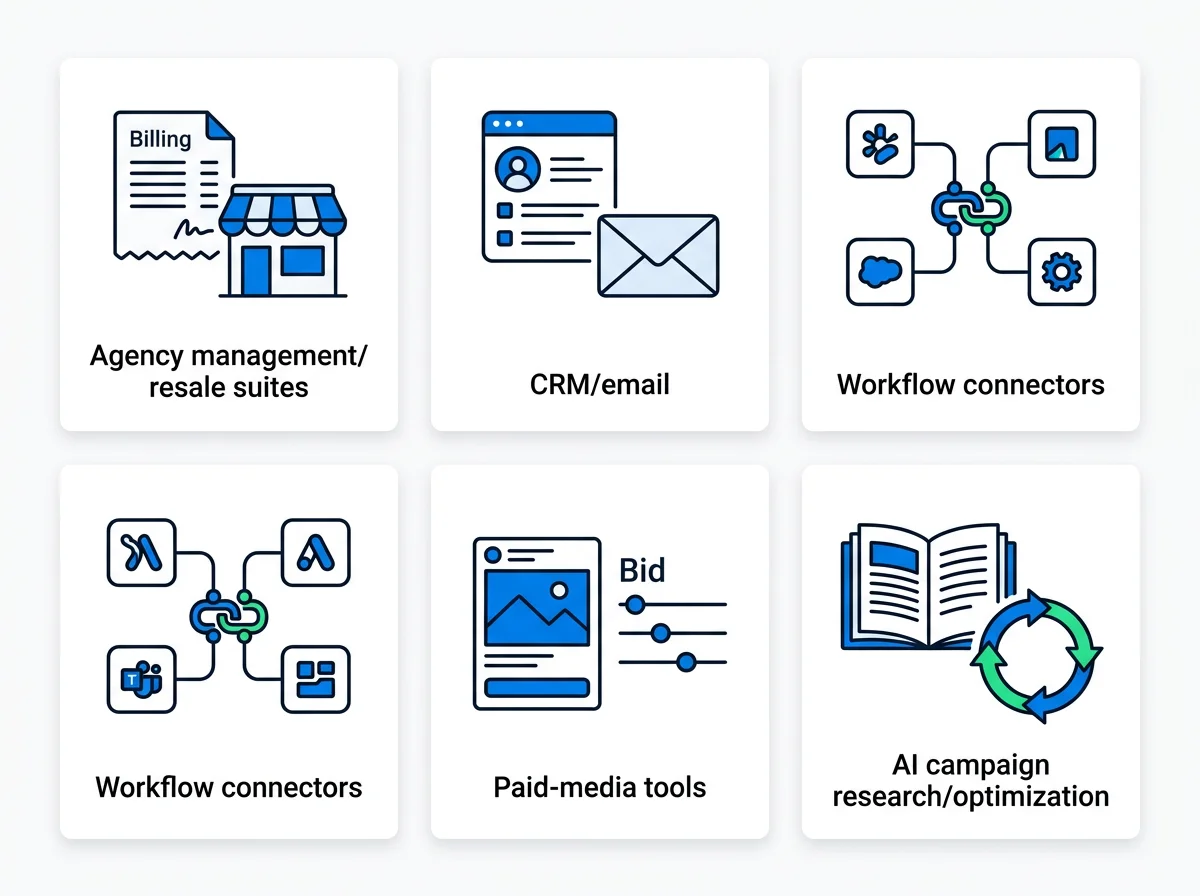
1. Agency management and resale suites
These center on operating an agency service across clients: account organization, access controls, approvals, branding, and resale arrangements. VBOUT emphasizes centralized client management, workflow replication, permissions, and white labeling. Those are relevant operational requirements, but they are a different evaluation layer from diagnosing why a campaign is not producing booked conversations.
2. CRM and email automation platforms
These organize contacts and lifecycle communication through email campaigns, CRM records, and automated sequences. Platformly emphasizes email marketing, automation building, CRM, landing pages, and reporting. This category is useful when contact management and nurture are the main bottlenecks; assess paid acquisition and post-click analysis separately.
3. Workflow connectors
Workflow connectors move information and trigger actions between applications. viaSocket emphasizes app connections, workflow logic, reusable templates, and AI agents. A connector can support handoffs, but transporting data is not the same as researching a campaign angle or deciding which conversion bottleneck to address.
4. Paid-media tools
Paid-media tools focus on advertising actions such as keyword planning, creative, campaign setup, and optimization. Compare the exact actions and channels you need. Google Ads keyword research, Meta campaign publishing, and conversion-signal setup are distinct capabilities; “supports advertising” is too broad to serve as a purchasing criterion.
5. AI campaign research and optimization platforms
This category connects research and campaign creation with execution and improvement. Superpage fits here: coordinated AI agents research the market, shape the campaign angle, build assets, and support publishing and optimization across connected marketing tools. Its campaign workflow also includes AI CRO and AI Voice Agents that call leads as appointment setters.
These categories can be combined. An agency may need an administration suite alongside a campaign platform, or retain a lifecycle platform while changing its acquisition workflow. Choose around the problem you need to solve rather than forcing every requirement into one category.
A practical agency evaluation checklist
Use one representative client campaign to evaluate marketing automation tools for agencies. Start with its audience, offer, channels, qualification criteria, and desired next step. Then work through these seven areas.
Campaign research and planning
Look for a clear connection between audience research and the campaign brief. Useful outputs include buyer questions, positioning, campaign angles, and keyword opportunities. The test is whether those outputs guide the assets your team builds—not merely whether the platform produces a research summary.
Campaign building and publishing
Map the steps from brief to live campaign. Identify where pages, forms, ad copy, creative, and follow-up are created and edited. Keep asset generation separate from publishing: producing an ad is not the same action as publishing it to an advertising account.
Paid-media execution
List required actions by channel. For Google Ads, that might include keyword research, keyword and negative-keyword lists, and CAPI implementation. For Meta, it might include copy and creative generation, structure, targeting, publishing, and Pixel or Conversions API setup. Compare those actions individually.
Measurement and attribution
Define which conversion events matter to the client. Separate visits, submissions, qualified leads, bookings, and deals. Attribution should help you connect acquisition touchpoints to those events, while keeping first-touch and last-touch views distinct.
Conversion-rate optimization
Look for the evidence behind optimization recommendations. Session recordings reveal how visitors navigate a page or form. Attribution adds acquisition context. A useful CRO process turns that evidence into a specific hypothesis, change, and measurement plan rather than a generic instruction to improve the page.
Lead response and appointment setting
Follow a submission through qualification, routing, contact, and booking. Identify the trigger, the next action, and the stopping condition for follow-up. Appointment-setting calls deserve their own evaluation: a captured lead and a booked conversation are different outcomes.
Repeatability and operating complexity
Document what your team repeats for each campaign and what changes by client. Track manual transfers, duplicated setup, and decisions requiring a specialist. Evaluate process repeatability separately from multi-client account administration; a coherent campaign process does not automatically establish client-workspace capabilities.
Where Superpage fits: a capability-level comparison
Superpage is an AI marketing platform for researching, building, publishing, and optimizing campaigns across connected marketing tools. The comparison below focuses on the campaign actions relevant to a performance-marketing team.
| Evaluation area | Why agencies care | Evidence to look for | Superpage capability |
|---|---|---|---|
| Research and creation | Keep campaign direction connected to assets. | Research outputs carried into messaging and campaign assets. | AI agents research the market, shape the angle, and build campaign assets. |
| Google Ads | Align keyword decisions and conversion signals. | Keyword outputs, negative keywords, and conversion-signal setup. | Keyword research, generated keyword and negative-keyword lists, and CAPI implementation. |
| Meta Ads | Connect acquisition setup with the funnel. | Creative, structure, targeting, publishing, and tracking actions. | Generates copy and creative, configures campaigns, publishes to a connected Meta account, and supports Pixel and Conversions API setup. |
| Attribution-informed CRO | Locate post-click friction and choose the next test. | Behavioral evidence and acquisition context behind recommendations. | AI CRO analyzes actual session recordings and first-touch and last-touch attribution to identify bottlenecks and recommend improvements. |
| Lead appointment setting | Give captured leads a next step toward a conversation. | The contact and appointment-setting path after submission. | AI Voice Agents call leads as appointment setters. |
| Workflow improvement | Keep iteration connected to campaign execution. | A process spanning research, assets, launch, and optimization. | Campaign research, building, publishing, and optimization across connected marketing tools. |
Keep agency administration separate: white labeling, client workspaces, permissions, billing, and other agency-management features are not established by the Superpage campaign capabilities covered here. Treat them as a separate requirement set, not as implied benefits of an AI campaign platform.
Walk through a campaign from research to appointment
Consider an agency running a demo-generation campaign for a B2B service. The goal is a qualified conversation—not simply a completed form. Use this walkthrough to inspect how the workflow supports that goal.
- Research the opportunity. Define the target buyer, offer, buying questions, and campaign angle. Superpage's campaign research and positioning supports that planning stage. Use Google Ads keyword research and CAPI implementation as distinct planning and conversion-signal tasks.
- Build and publish. Carry the angle into ads, pages, and forms. For Meta Ads, Superpage generates copy and creative, configures campaign structure and targeting, and publishes to a connected Meta account. Keep those Meta actions distinct from Google Ads keyword support.
- Read conversion and attribution signals. Compare the acquisition context of visitors and leads. Review first-touch and last-touch attribution alongside the conversion events you selected.
- Inspect the post-click experience. Use actual session recordings to investigate where visitors hesitate or abandon the journey. AI CRO analyzes recordings and attribution to identify bottlenecks and recommend what to optimize next.
- Make a focused change. Turn the finding into a testable hypothesis. For example, if sessions show confusion around the next step, test clearer booking expectations. Measure the affected stage and downstream qualification rather than judging the change only by total submissions.
- Move leads toward an appointment. Apply qualification and routing, then follow the contact path. Superpage's AI Voice Agents call leads as appointment setters; calendar and follow-up capabilities support the booking journey.
- Reassess the campaign. Compare qualified leads, bookings, and pipeline progression with the original objective. Use the next bottleneck to guide the next iteration instead of changing targeting, creative, forms, and follow-up simultaneously.
This walkthrough gives the agency a consistent evaluation method: identify the action, the evidence it uses, the handoff it creates, and the outcome you will measure.
Compare operating cost and complexity without guessing ROI
Compare a platform with your actual alternative: the combination of tools and processes your team would otherwise use. Separate software charges, usage-based costs, implementation work, ongoing configuration, and campaign operating time. Keep media spend distinct from software cost.
For a connected stack, map the systems involved at each stage and the handoffs your team maintains. For a broader platform, map the campaign actions it covers and the tools or processes that remain external. Neither fewer tools nor more automation is a complete measure of fit.
- Which channel actions does this campaign require?
- What data informs each optimization decision?
- How will the team evaluate qualified demand rather than raw activity?
- What happens after a lead submits the form?
- Which handoffs remain manual or external?
- Which agency-management requirements sit outside the campaign workflow?
The strongest comparison is a concrete campaign path with clear responsibilities—not an assumed return, an advertised feature count, or a claim that one platform replaces everything.