
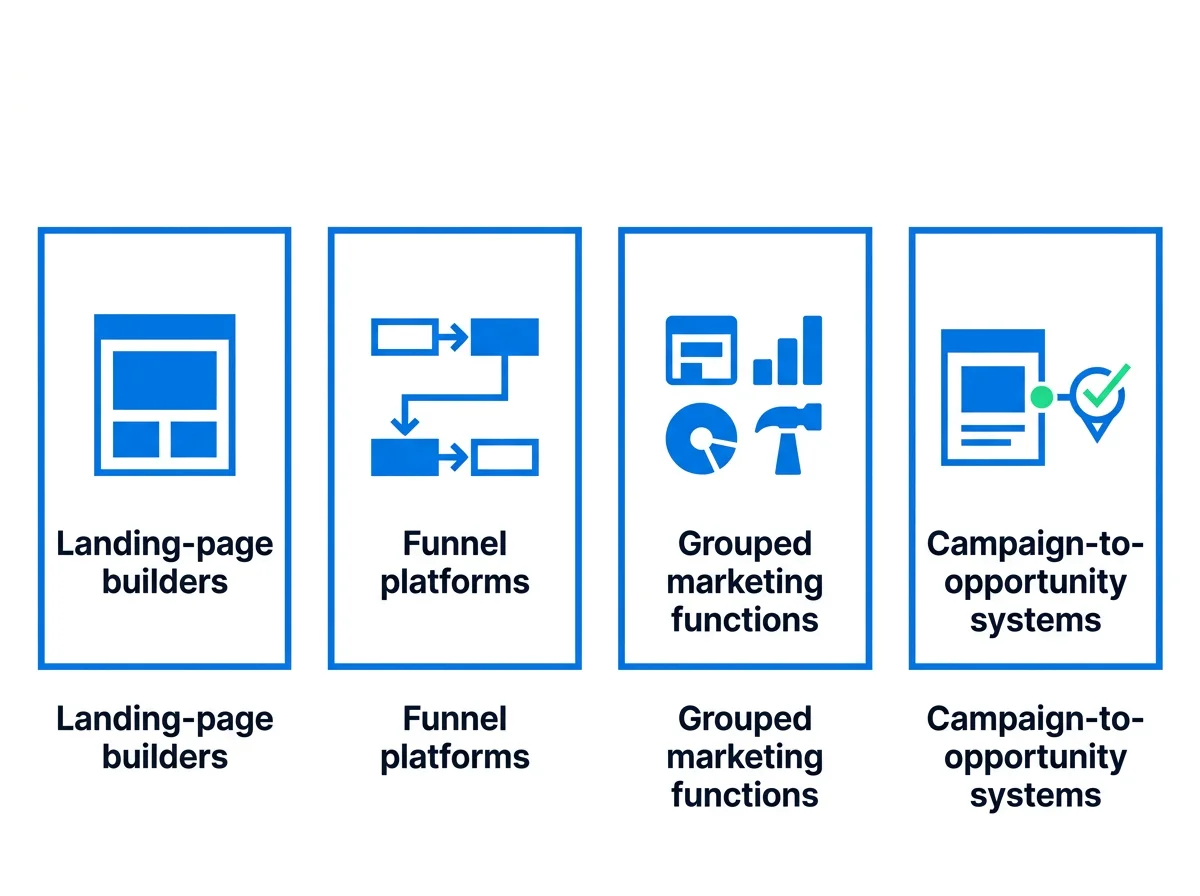
Looking for Unbounce alternatives? Start with what you want to change. A different landing-page builder can address an editor preference or page-publishing cost. A funnel platform serves a different job: moving buyers through checkout and upsells. And a connected campaign platform becomes relevant when your problem starts before the page—or continues after someone submits a form.
This guide compares seven options by that distinction: Leadpages, Instapage, Landingi, Swipe Pages, ClickFunnels, Systeme.io, and Superpage. The goal is a useful shortlist, not one universal winner.
Why look for an Unbounce alternative?
Switching usually comes down to one of four issues: the cost of the testing workflow you need, traffic allowances, growing team or domain requirements, or work that falls outside the landing page.
Those are different buying problems. If your pages perform well and your CRM handoff works, replacing your whole marketing system may add unnecessary work. If leads regularly stall after submission, a cheaper page editor alone will not address that bottleneck.
- Cost: compare the plan needed for your actual workflow, especially testing—not just the entry plan.
- Scale: account for campaign traffic peaks, client domains, and everyone who needs access.
- Production: consider editing flexibility, review cycles, and how many pages you build.
- Lead progression: include qualification, follow-up, booking, and pipeline ownership in the decision.
Unbounce at a glance: a focused page and CRO platform
Unbounce’s 2026 product materials describe a no-code drag-and-drop landing-page builder with more than 100 templates, mobile page control, custom scripts, and publishing to your own domain. They also describe forms, multi-step forms, popups, sticky bars, and Dynamic Text Replacement based on search terms.
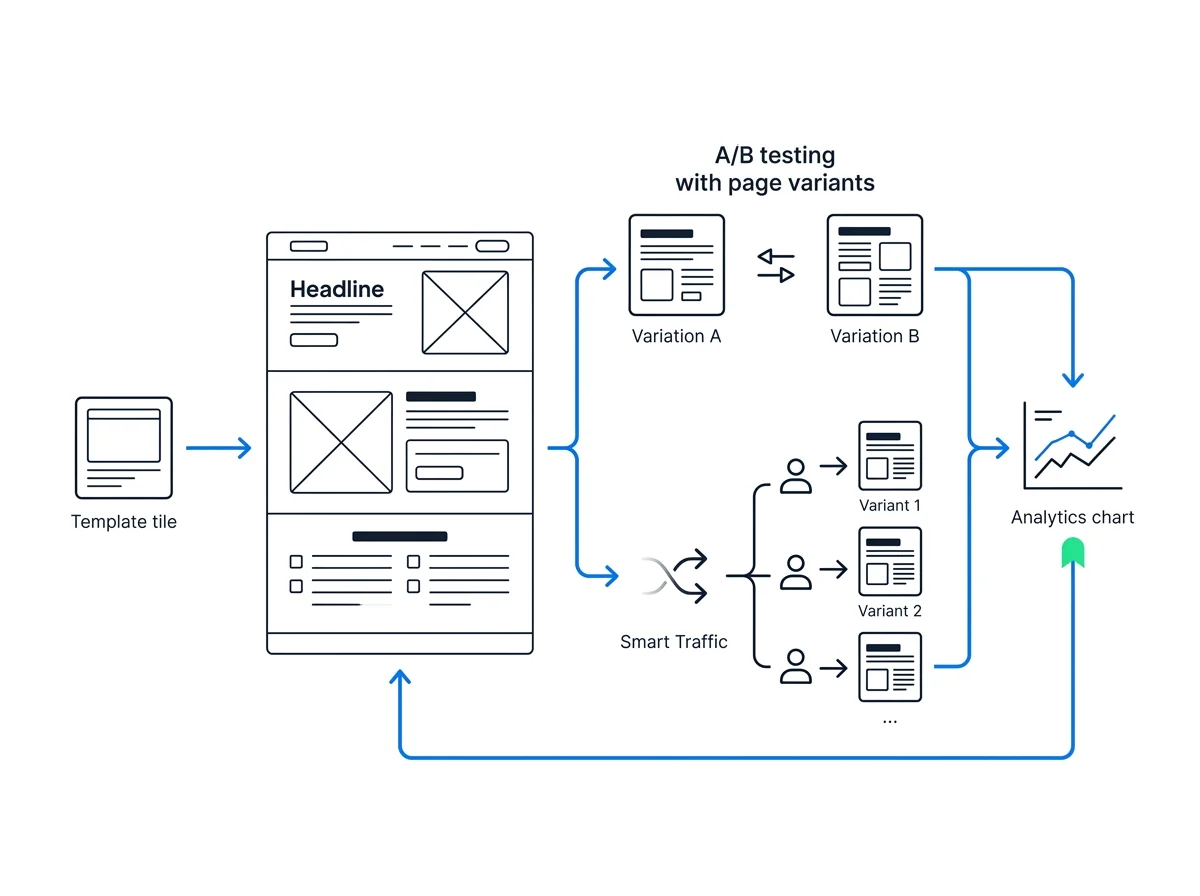
For experimentation, Unbounce documents native A/B testing with configurable traffic allocation and reporting. Its Smart Traffic feature uses AI to route visitors toward page variants they are more likely to convert on. These are distinct approaches: A/B testing compares variants through an experiment; Smart Traffic focuses on visitor routing.
Unbounce also documents AI copywriting, analytics, and connections to Google Analytics, CRMs, marketing tools, Zapier, and webhooks. Its core value is clear: build campaign pages, experiment with them, and improve page-level conversion.
The right replacement depends on whether you need a better page workflow—or a better path from campaign to opportunity.
Keep Unbounce on your shortlist when focused landing-page creation, native experiments, and AI-assisted visitor routing are the central requirements. A broader platform is not automatically a better fit for that job.
Quick comparison: separate the categories first
A page builder, a sales-funnel platform, and a CRM suite can all appear in an alternatives list. They should not be treated as interchangeable. Use this category-fit table to narrow the search.
| Category | Options | Best reason to consider it | Main trade-off |
|---|---|---|---|
| Focused landing pages and CRO | Unbounce; Leadpages, Instapage, Landingi, Swipe Pages | Page creation, production, testing, or editor needs | Plan the CRM and follow-up handoff separately |
| Funnel-first platforms | ClickFunnels, Systeme.io | Multi-step sales journeys, checkout, upsells, or email | Choose around the funnel, not assumed page-testing equivalence |
| Broader CRM and marketing suites | HubSpot, GoHighLevel | A wider marketing and lead-management operating system | A larger workflow decision than replacing a page editor |
| Connected campaign-to-opportunity execution | Superpage | Connect research, ads, pages, qualification, follow-up, booking, and pipeline | Evaluate the connected workflow rather than a like-for-like page-tool swap |
Four direct Unbounce alternatives
Leadpages, Instapage, Landingi, and Swipe Pages are the most direct comparison candidates when landing-page work remains your primary need. The useful distinction is how each fits your production and optimization priorities.
| Option | Use-case fit | Editor, testing, and collaboration focus | Limits and pricing to compare |
|---|---|---|---|
| Leadpages | Solo marketers and small teams seeking a lower-cost page-building option | Ease of editing; testing-enabled plan; review needs | Traffic model, users, domains, and total testing-tier cost |
| Instapage | Larger paid-media teams with collaborative page production | Ad-to-page workflow, team review, and higher-end page optimization | Visitor capacity, collaborators, domains, and team-level pricing |
| Landingi | Agencies and high-volume landing-page production | AI page generation, testing workflow, and repeatable editing | Visitor limits, page volume, seats, and client-domain needs |
| Swipe Pages | Budget-conscious marketers prioritizing testing and mobile speed | Mobile-speed positioning, editor fit, and testing cost | Traffic allowance, users, domains, and the usable testing tier |
1. Leadpages: a practical small-team shortlist
Leadpages belongs in the comparison when your main aim is economical page building rather than a broader campaign system. For a solo marketer or small team, the buying question is straightforward: can you publish and improve the pages you need at a workable total cost?
Compare the entry publishing plan with the plan needed for testing. Then factor in traffic, domains, and access for anyone helping with production. Editor comfort matters too: assess a real campaign page with your own form, mobile layout, tracking, and brand requirements.
Best fit: a compact page-production workflow. Keep lead follow-up and CRM integration in the operating-cost calculation.
2. Instapage: collaborative paid-media page production
Instapage is a direct candidate for larger paid-media teams, particularly when ad-to-page alignment and collaboration shape the workflow. Its positioning is more relevant to coordinated campaign production than to finding the simplest inexpensive publishing tool.
Evaluate how a marketer, designer, and reviewer would move a page from first draft to launch. Compare optimization needs alongside visitor capacity, collaborator access, and domain requirements. A tool that suits one operator may not suit a team with several review stages.
Best fit: teams where collaboration and paid-media page operations carry substantial weight.
3. Landingi: high-volume pages and agency use
Landingi is worth considering when you produce many landing pages across campaigns or clients. Its AI page-generation and testing positioning makes it relevant to teams balancing production volume with ongoing optimization.
For agency use, compare more than the number of pages you can publish. Map visitor allowances, team access, and client domains to your actual account structure. Also assess the editor against repeatable work: similar campaign layouts, frequent changes, and mobile adjustments.
Best fit: page-heavy operations where repeatable production and account scale matter.
4. Swipe Pages: mobile speed and testing-budget priorities
Swipe Pages belongs on the shortlist when mobile-speed positioning and lower testing cost are central concerns. That makes it a useful direct comparison for marketers who want to stay focused on landing pages rather than adopt a larger marketing suite.
Compare the testing workflow you need with the plan cost, traffic allowance, and domain footprint. Include the practical editing work: your page structure, scripts, forms, and mobile experience. A low subscription cost is only useful if the platform supports the campaign you actually run.
Best fit: a focused landing-page workflow with strong attention to mobile experience and budget.
Funnel-first alternatives: a different buying job
5. ClickFunnels: multi-step revenue funnels
ClickFunnels is relevant when the journey includes checkout, upsells, and multiple funnel steps. That is a different requirement from publishing a standalone lead-generation page and running page experiments.
For creators, coaches, or ecommerce teams, prioritize the buying journey: what happens between the first click, purchase, and next offer? If that is your main concern, see the fuller ClickFunnels alternatives comparison.
6. Systeme.io: funnel and email entry point
Systeme.io is a free or low-cost entry point for funnel and email workflows. It belongs in this guide for buyers who need those functions together and do not need the same depth of specialized page-conversion work.
Choose around the funnel and email sequence you intend to run. For a team whose core activity is controlled page experimentation or visitor routing, a focused CRO platform remains a separate evaluation.
Where broader CRM suites fit
HubSpot and GoHighLevel belong in the broader marketing and CRM category, not the closest page-builder category. Bring them into the search when lead management and marketing operations are the reason for switching. For that decision, use the dedicated GoHighLevel alternatives guide rather than expanding a landing-page shortlist indefinitely.
7. Superpage: when the workflow extends beyond the page
Superpage overlaps with Unbounce in pages and CRO, but serves a broader job: connecting campaign planning and execution to qualified, bookable opportunities.
Before page creation, Superpage provides AI market intelligence, competitor context, positioning, and campaign strategy. It connects campaign research, build, publishing, and optimization with Google Ads keyword research and CAPI, plus Meta Ads creation and deployment.
After the click, the workflow includes pages, funnels, forms, and lead qualification. Automation supports email/SMS follow-up and booking, while CRM and pipeline capabilities support lead progression. Campaign Canvas and analytics connect the work across the campaign.
Superpage’s AI CRO uses actual session recordings, alongside first- and last-touch attribution. Its AI Voice Agents call leads as appointment setters. These capabilities make it relevant when a form submission is only the beginning of the job.
The optimization distinction matters: Unbounce’s documented workflow includes native A/B testing and Smart Traffic. Superpage’s CRO workflow centers on actual session recordings and campaign attribution. Evaluate these as different optimization approaches, rather than treating their feature sets as interchangeable.
Best fit: teams that need research, paid-media execution, qualification, follow-up, booking, CRM, and appointment setting connected to their pages. Explore AI CRO and AI Voice Agents for those specific parts of the workflow.